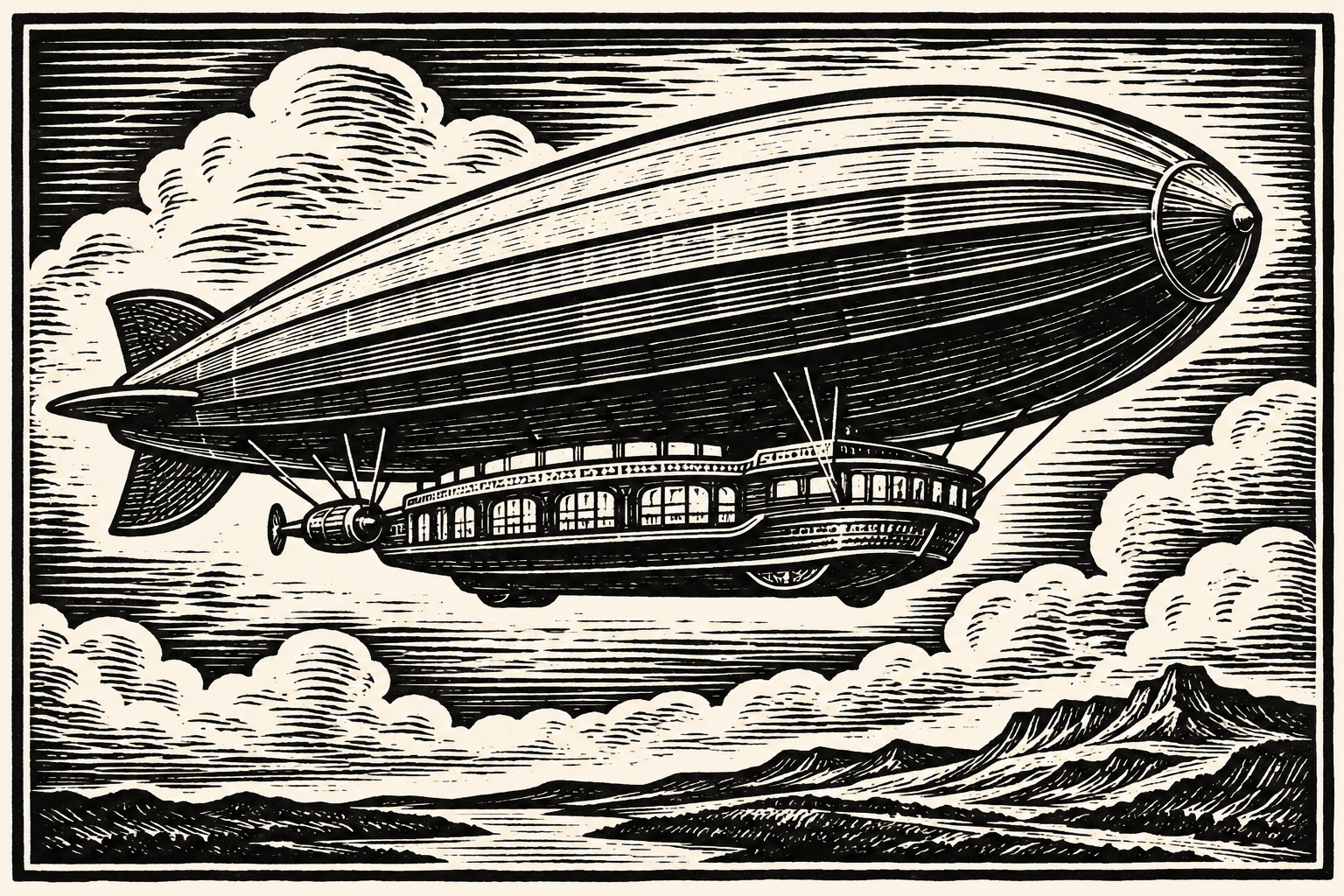
As war looms over the continent, a new hydrogen zeppelin, the Nordstern, slips her moorings in Frankfurt bound for New York. An original short story written in the style of 1930’s Pulp Fiction, this tale is a thrilling 1939 zeppelin adventure.
Rhein-Main Airfield, Frankfurt, June 1939
The steward held out a silver tray.
“Matches, mein Herr. Lighters. Anything that makes a spark.”
Jack Brandt emptied his coat pocket. One box of Swedish safety matches. Half full.
He set it on the tray. The steward thanked him and moved on.
Jack kept one match. It was tucked behind the sweatband of his hat. Old habits.
Above him the Nordstern filled the evening sky. Eight hundred feet of silver skin. Swastikas on the tail fins. Searchlights crawled along her belly. She was the newest ship in the German fleet. She flew on hydrogen because America would not sell Germany helium.
Hydrogen. Jack had read the newspapers in 1937. Everybody had.
“Herr Brandt?”
The voice was soft. Polite. Jack turned.
The man wore a gray civilian suit that fit him like a uniform. Pale eyes. A small smile that never reached them.
“Sturmbannführer Erich Voss,” the man said. “Security. We are responsible for the passengers’ safety on this crossing.”
“Swell,” Jack said. “I feel safer already.”
“You sell instruments. Gauges. Calipers. Yes?”
“Precision instruments. Milwaukee’s finest.”
“And you were at the docks on Tuesday, Herr Brandt? The night the Gestapo lost a prisoner by the river?”
Jack smiled. “I was at the opera on Tuesday. Wagner. Four hours. I’d remember a dock.”
“Would you?” Voss tipped his hat. “We will talk again. It is a long way to New York.”
He walked off toward the gangway.
Jack let out a breath. On Tuesday a man in a black mask had pulled a Jewish printer out of a Gestapo car by the Main River. The masked man left a snuffed match on the car’s hood. New York papers called him the Lamplighter.
Jack had never seen the printer again. He hoped the man was in Holland by now.
“You are nervous, young man. Everybody is nervous the first time.”
An old man stood at his elbow. White mustache. A cardboard suitcase tied with string. He held a yellowed slip of paper in both hands like a holy relic.
“Elias Brenner,” the old man said. “Bookkeeper. Retired. Friedrichshafen.”
“Jack Brandt. Salesman. Not retired.”
Brenner held up the paper. “Do you know what this is?”
Jack squinted. It was a ticket. Printed in 1920. Luftschiff Nordstern. Friedrichshafen. Berlin. Stockholm.
“There was another Nordstern?”
“The first one. LZ 121. Built for the Stockholm route. I bought a ticket to go marry a Swedish girl. Ingrid.” Brenner sighed. “The ship never flew the route. In 1921 the French took her. Reparations. They renamed her Méditerranée. Scrapped in 1926.”
“And Ingrid?”
“The first Nordstern, young man, went to the French. Like my Ingrid’s letters, she simply stopped arriving.” He folded the ticket away. “Nineteen years I waited to fly on a Nordstern. Tonight I fly.”
The ground crew shouted. Ropes slapped. Jack followed the old man up the gangway into the belly of the ship.
The Chief Steward served dinner at nine.
Consommé. Then fish. Then tenderloin on toast. The dining room ran down the whole port side of A deck. Silk paintings on the walls. White linen. Real silver.
Jack ate and watched.
There were thirty-one passengers. He counted. Salesmen do.
At the far end of the lounge a woman played the piano. Lotte Krämer. Tall, dark, theatrical. She tickled the keys like they owed her money. The piano was aluminum. A Blüthner. It weighed less than a fat man and echoed like a church.
A small man in a brown suit stood behind it. Paul Weller, piano tuner. He had a leather kit of hammers and mutes. Between Krämer’s pieces he leaned in and tightened a pin. He hummed while he worked. Mendelssohn. Jack recognized the tune. It was not a tune anybody hummed in Germany these days.
Weller kept looking across the room. At Voss.
Every time Voss looked back, Weller dropped his eyes.
“Interesting man,” said the gentleman beside Jack.
Dr. Anselm Roth. Gray beard. Chemist’s hands, stained yellow at the fingertips. He worked for IG Farben and carried a fat leather wallet he never let go of.
“The tuner?” Jack asked.
Roth leaned close. His voice dropped.
“That man is not a tuner. He needs…”
A shadow fell over the table.
“Dr. Roth.” Voss smiled down at them. “We were hoping you would join us for a cigar. Before the smoking room closes?”
Roth closed his mouth. He folded his napkin. He did not finish the sentence.
“Of course, Herr Sturmbannführer.”
Across the table, old Brenner tapped his water glass. The water sat slightly tilted.
“You see that?” Brenner said to nobody. “She trims heavy forward. Right by the lounge. For forty years I kept books on freight. I know when something weighs more than the ledger says.”
Nobody listened to him. Nobody ever listened to a bookkeeper.
The smoking room was on B deck.
It was the only place on the ship a man could light a cigarette. It was kept at higher pressure than the rest of the ship. If hydrogen ever leaked, it would be pushed out, not sucked in. You entered through a double door airlock beside a little bar. The barman watched everybody come and go.
His name was Ernst Pohl. He was thin and gray and he counted things out loud.
“One lighter,” he told Jack at eleven thirty. “Electric. Mounted on the wall. Nobody takes fire out of this room. Nobody.”
“I believe you.”
“I was at Lakehurst. May 1937. Ground crew.” Pohl wiped a glass. “Thirty six people. I counted them after.”
Jack did not ask anything else.
At midnight Pohl sealed the room. One passenger remained inside. Roth. He wanted one last cigar alone, he said, with the lights of the Rhine below the sealed windows.
Pohl wrote it in his log. 24.00. Dr. Roth. Alone.
Jack went to bed.
At one in the morning somebody screamed.
Jack was in the corridor in his shirtsleeves before the second scream. Passengers spilled out of fabric cabins. A steward ran past.
The airlock stood open. Pohl stumbled out of it, both hands over his eyes.
“My head,” he gasped. “I can’t see. Everything is dark. Everything… so small.”
Jack caught him. Pohl’s pupils were pinpricks. Black dots in gray glass.
Through the inner door Jack saw Roth.
The chemist sat in a leather chair by the window. His cigar had fallen to the carpet, unlit. His eyes were open. His pupils were tiny. There was no blood. No wound. Just a faint smell in the air. Sweet. Like fruit left too long in a bowl.
Jack started forward.
A hand stopped him.
“No, Herr Brandt.”
Voss stepped past him into the room. He walked straight to the body. He bent over Roth and studied the dead man’s face. He breathed the air. He stood there a full minute.
Nothing happened to him.
Jack noticed that. He noticed Voss’s eyes, too, in the electric light. Wide. Black. Like a cat’s at night.
He filed it away. He did not know yet what drawer it went in.
The captain arrived in a dressing gown. Kapitän Albrecht Sander. Short, square, worried.
“A heart attack,” the captain said. “Yes? An old man. A cigar.”
“Perhaps,” Voss said. “But we will investigate, Kapitän. Quietly. Nobody must panic. Not on this ship. Not with this hydrogen over our heads.”
“Of course.”
“The room stays sealed. I take charge of the inquiry. On the authority of Berlin.”
The captain nodded. He looked relieved to hand it over.
Voss turned. His eyes found Jack.
“Herr Brandt. You sat with Dr. Roth at dinner. He whispered to you. We saw it.”
“He was telling me about the fish.”
“Was he? Then you will tell us about the fish. At length.” Voss nodded to two stewards. “Herr Brandt is confined to his cabin. A guard at the door. Nobody visits him.”
“You’re arresting me?”
“We are protecting you,” Voss said. “Somebody aboard this ship has killed a man without leaving a mark. You were the last one he spoke to. If you are innocent, you are in danger. If you are not…”
He shrugged.
The stewards took Jack by the arms.
He let them. Fighting on a hydrogen ship was a bad idea. He had a feeling it was going to come to that anyway.
They walked him down the corridor past the dark windows. Somewhere below, the Atlantic waited.
The door of his cabin closed. A key turned.
Jack sat on his bunk in the dark.
A man was dead from something nobody could see. The killer was still aboard. So was the weapon. And the only man who had tried to warn him was cooling in a sealed room above sixteen gas cells full of hydrogen.
Jack Brandt was a prisoner.
Somewhere on this ship was death. Only death wasn’t locked up.
Part Two coming
© 2026, Michael Shawn Sommermeyer. All rights reserved.


Leave a Reply