Wordsmith Holler

Original Pulp Fiction

Author: Michael Shawn Sommermeyer

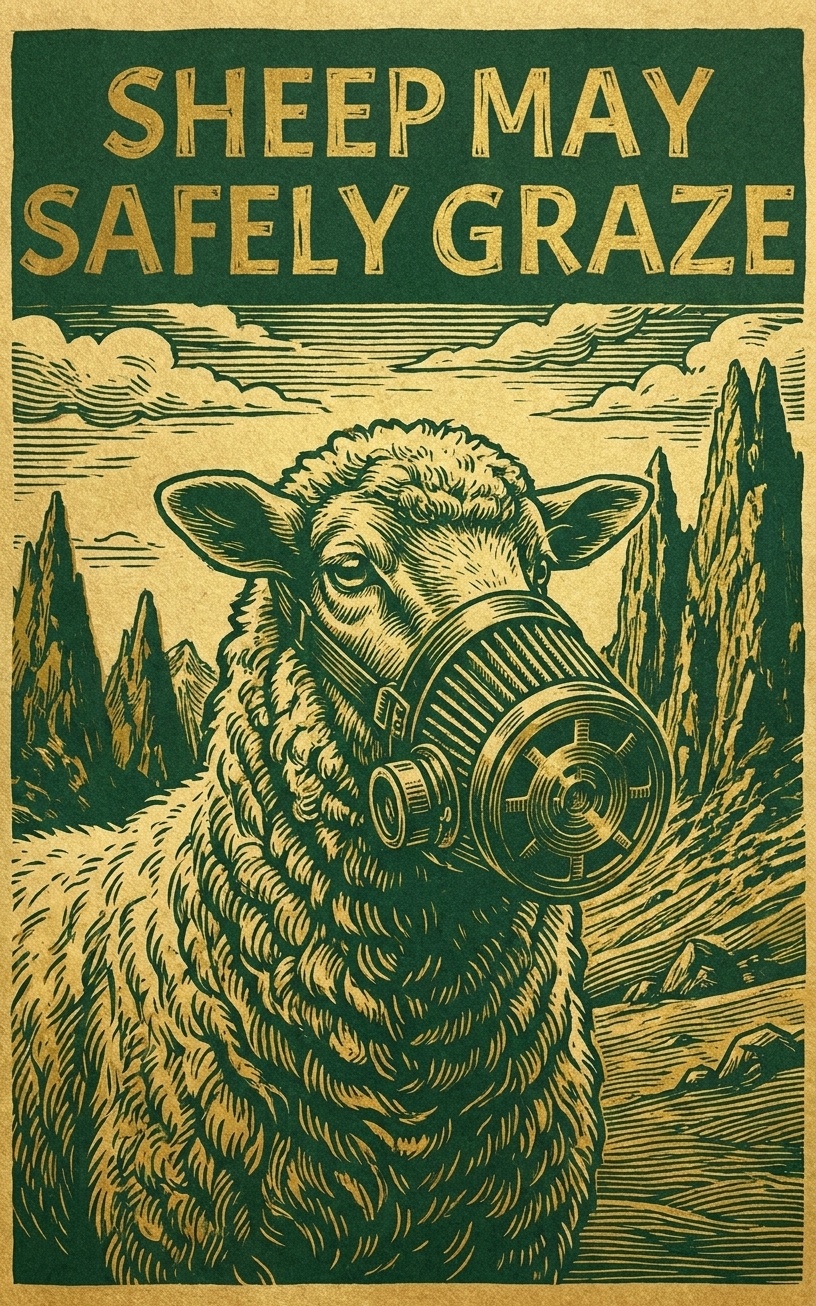
  • Sheep May Safely Graze: Sheep May Safely Graze (Part 5)

    Sheep May Safely Graze: Sheep May Safely Graze (Part 5)

    Xabier did not sleep. He sat at the workbench with the note and the map and the gun. Xabier tried to remember writing the words. He could not.

    At some point his hand went to the back of his neck. It did that when he was tired. There was a little ridge of scar at the base of his skull, smooth and round, about the size of a coin. Xabier had always had it. He had a vague idea; he got it falling off a wall in the village. He could not remember the wall.

    He stood up and looked at the flock.

    “Which of you knew?” he asked them. “Eh? Which of you watched me write it?” Maite lay near the gate with her chin on Ander’s back. The black sheep stood off by himself, the way he always did. The black sheep never stared. Xabier had never thought about that either.

    The freighter had holds aft of the barn. The company man at Barcelona had told him they were sealed. Old cargo, nothing to concern a shepherd. Xabier had never thought about them. Now he took his staff and a length of wire and went to the rear bulkhead.

    The hatch was rusted shut, but rust was nothing. He worked the wire into the lock and the staff into the seam and leaned. He leaned harder. The hatch groaned and gave. Cold air rolled out over his boots and set the sheep stamping in the dark behind him.

    The lights came on as he stepped through. Long white tubes, one after another, down a long low room.

    Berths. Tanks of clear glass, each one long enough for a man, stacked two high along both walls. He walked down the row and counted them. Fifty on the left. Fifty on the right. One hundred.

    Ninety-nine were cracked open. Their lids hung on bent hinges. Dried sleep fluid stained the floor under them in old brown rings. Some of the stains were so old they had flaked away.

    One berth was different. The last one, at the end of the row. Its lid was closed and clean. The fluid inside was fresh and blue. A feed line hung from the head of the berth, and at the end of the line was a small round plug.

    About the size of a coin.

    Xabier touched the back of his neck again.

    Above the berth, a plate read 100.

    He walked back up the row and read the plates. 1. 2. 3. All the way to 99. Some of the old berths had things left in them. A boot. A comb with teeth missing. In berth 41 someone had scratched a little sheep into the glass with a nail, and under it, in a crooked hand, egun ona. In berth 63 there was a jar. The jar was empty, but the inside was stained red.

    He did not touch it.

    “Pomegranate,” he said, and his voice came out small in the cold room, like a boy’s in a church.

    He stood there a long time. The loudspeaker clicked. Somewhere in the barn the Cantata began, the slow opening bars of a movement. Xabier didn’t remember ever having heard it play. A panel beside the berth lit up. Words scrolled across it in plain block letters.

    SOLITON PASTORAL TRUST. SHEPHERD CYCLE LOG.

    He touched the panel. The music changed with every page. He read.

    This was a template. One man, indentured, Basque, twenty years old. The Trust owned his pattern under the terms of his contract. Each cycle, the ship grew and thawed one shepherd who tended the flock. When the pattern aged out, or died, or failed, the next one was thawed. The old one was “released to the plain.” Supplies for one. Barn for one. Rations for one.

    There was a note under crew orientation. Shepherds were told that time took on a different meaning on the plain. Decades passed on Earth while he aged a year. An explanation for any lost memories.

    He thought about his mother making jelly. Long dead, he had presumed. He had presumed so many things.

    At the bottom of the log was the manifest. He read the last line twice.

    SHEPHERD STOCK: 99 AND 1.

    Ninety-nine spent. One active.

    He had counted his flock the first day by that number. He had laughed at the company’s poor way of saying one hundred sheep. It had never been about sheep.

    He was the one. He was copy one hundred.

    “Ehun,” he said, the way a farmer reads a bad price at the market. “One hundred. Not a shepherd. A number on a shelf.”

    He read the rest of it because he could not stop. Cycle lengths. Ration weights. A column for each copy with a date thawed and a date released. Some of them had lasted years. Some of them had lasted weeks. Copy 12 had a note beside his number. Refused belt. Released early. Copy 58 had a note. Attempted to open aft hold. Released. Copy 97 had a date thawed and nothing else. No date released. No note. Only a blank.

    He scrolled to his own line. Unit 100. Active. The date thawed was forty years after the date the freighter landed. Nineteen months of hibernation along the Soliton Fold, he believed. He had never been in the fold. He had been in a tank fifty steps from his own bed waiting to be thawed.

    He thought of the spaceport outside Barcelona. He could see it. The gate. The smell of fuel. The company man with the clipboard. He could see all of it as clearly as he saw his hand. He was sure of it.

    Somebody had been there. Somebody had run as fast as he could to that spaceport. Only it wasn’t him. Trust had taken that running boy and put his thoughts, memories, and all in a hundred heads.

    “Gizon adimentsua,” he said to the empty berths. He did not smile this time.

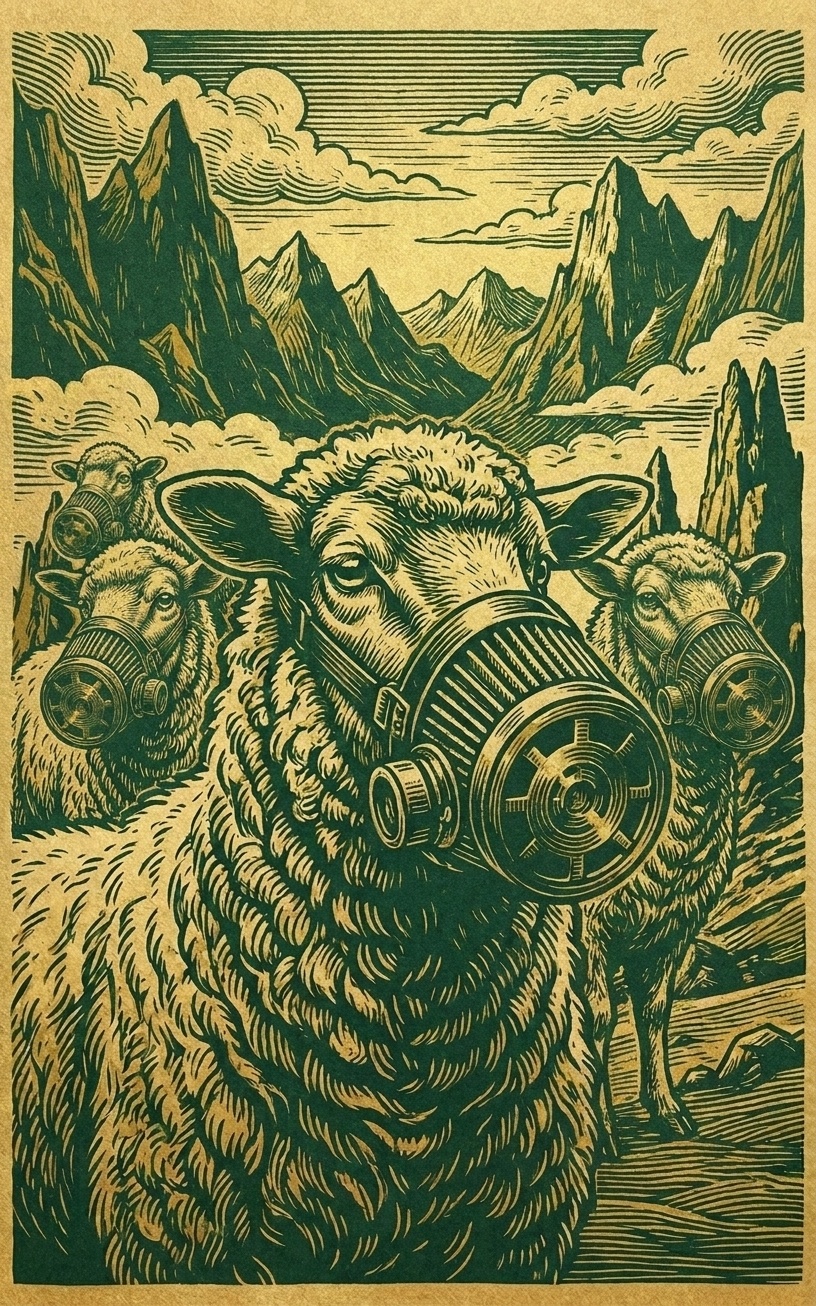
    Xabier went back through the barn in a daze. The flock was awake. They stood in their filters in the dark, and a line of ewes stood apart from the rest, staring at him, the way they had stared when he worked at the bench. He walked past them. Their heads turned, slow, all together, following him.

    He stopped. He took a step left. The heads turned left. He took a step right. The heads turned right.

    Xabier looked down at his weight belt.

    It was a plain thing. Heavy canvas with lead bars sewn in pockets. But one pocket had always been stiffer than the others. He had thought it was a bad bar. He cut the stitches with the tip of his shears. Inside lay a flat black wafer the size of a playing card, with a single green light that glowed around his fingers.

    He unbuckled the belt and hung it on a hook by the door. He walked to the far end of the barn.

    The ewes did not follow him with their eyes. They looked at the belt. A few of them drifted toward it, slowly, the way sheep drift toward a man with a bucket. He retrieved the belt. Every head swung back to him.

    “Zer zarete?” he asked them. What are you?

    They did not answer. They were sheep. But too mechanical. Too observant.

    He heard a snap. Hung the belt back and rushed to the window.

    The hunters crossed the array wire along the fence. A shiver of silver at the gate. Another at the south wall. Another, two more, on the roof. They did not go after the sheep. The sheep were locked in. Instead, he saw a blue snap, and a harpoon punched through the thin tin by the feed bins. The cable went tight. The bin tipped and slid and scraped across the floor and went out the slit window in a shower of grain.

    He ran for the bins. Another snap. Another bin went. He grabbed the last one and wrapped his arms around it and held on while the cable hummed and the bin bucked under him like a calf. Then the cable went slack. Someone out there had cut it rather than let it drag him through the window.

    He lay on the floor with his one bin of feed and listened to them go. Slowly his breath changed to a gentle sigh. The sheep slept under the belt.

    He did not sleep. He sat up with the hunter’s gun across his knees, and the lamp turned low. Around midnight, by his own count, the loudspeaker clicked, and the middle refrain of the Cantata played, the one he had heard the night he built the array. The line of ewes stood apart and stared at him. He stared back.

    “Who is watching?” he asked them. “Eh? Who is it?”

    The music stopped. The ewes kept staring.

    In the morning there was a sack by the door. It held berries, the red ones like pomegranates that tasted of apples. On top lay a note, folded in four.

    You are the hundredth. We are what is left of the others. Give up the belt, and the Trust will return you to the tank and take you back. Fight, and we will starve you.

    It was signed with one word. Zaharra. The Old One. The “Z” had a fishhook tail.

    He sat in the doorway with the sack in his lap. The red sun hung where it always hung. The white point burned beside it, a little brighter than yesterday.

    Xabier understood then. The hunters had never wanted the sheep. They had wanted him.

    Read more: Sheep May Safely Graze: Sheep May Safely Graze (Part 5)
  • Sheep May Safely Graze: Sheep May Safely Graze (Part 4)

    Sheep May Safely Graze: Sheep May Safely Graze (Part 4)

    The two suns climbed the west sky. One was an old red sun, fat and slow. The other was a small white point, sharp as a needle. It had not been there when Xabier first came to the Slydal Plain. He had stopped wondering about it. A planet this far out could keep whatever stars it liked.

    Below him, the five sheep grazed in the triangle corner of the field. The two rams pulled at the grass. The doe-eyed ewe stayed close to her lamb. The old ewe stood a little apart, chewing slowly, her weight belt sagging on her thin haunches. Xabier lay flat behind the rock with the controller in his lap. The buried wire ran under his elbow like a vein.

    He waited. Nymphs bounced in his hair. The locusts hummed. A sheep bleated far up the field, and the flock answered.

    Nothing moved in the corner.

    “Etorri,” he whispered. “Come on, then.”

    He set his thumb on the knob and turned it a hair. A needle on the dial twitched. He turned it again. The posts in the corner gave off a faint tick, tick, like rain on the freighter’s hull. He swept the dial slowly from one end to the other. Nothing. He swept it back.

    Halfway up the dial, the air in the corner shivered.

    It looked like heat over a road. Then it looked like a man. Four outlines stood among the bait sheep, silver grey, edged in thin light. A fifth stood farther back near the cliff, as if he had come to watch. They wore hoods and long cloaks that hung oddly in the heavy, still air. Filters covered their mouths, just like his own. Each held a long gun with a fat drum under the barrel, and a fine cable wound on the drum.

    They were men. Not monsters. Men.

    Xabier’s mouth went dry. He had pictured bows and arrows. He had pictured something with claws. He had not pictured men who breathed through filters and stood on two legs in his field.

    One of the outlines looked down at his own arm. He had seen himself go silver. He jerked his head around at the others. The array had worked. They knew it.

    The four hunters scattered like quail. But one of them was quicker with his fear than the rest. He swung his gun and fired. A blue flash snapped from the barrel, a spark where the cable left the cloak. The harpoon took the bigger ram in the neck from no more than ten meters off. The ram fell bleating. The drum whined, and the cable went tight, and the ram began to slide across the grass toward the rocks.

    “Ez!” Xabier was on his feet before he thought about it.

    He grabbed his staff and the shears from his belt. He pushed off the rock and flew. One stroke of the staff against the ground, then another, rowing through the dense air in long, low arcs. He came down beside the sliding ram and caught the cable in the blades of his shears. It was thin as fishing line and tough as wire. He squeezed with both hands. The cable parted with a crack and whipped back into the ripple.

    The ram lay still. Blood ran into the wool at his neck. Xabier knew that wound. He had seen it on three sheep already.

    The hunters ran for the cliffs. Their outlines flickered as they crossed the array wire, silver, then nothing, then silver again. The slowest of them was the one at the back, the watcher. He moved like a man with stiff knees. His cable trailed behind him, loose, unreeled, dragging through the bracken.

    Xabier dug in his staff and pushed. He flew. He landed with both boots on the trailing cable, and the old hunter jerked to a stop like a dog at the end of a lead.

    They both went down. In this gravity, going down took a long time. They tumbled together in a slow, ugly arc, cable wrapping their legs, the gun spinning away. The hunter’s elbow caught Xabier in the ribs. Xabier grabbed a fistful of zamarra. It was curly, tough leather, and he clung to the wool. It tore at the hood, and the hunter twisted away.

    They landed in the grass. Xabier toppled over. He held the torn hood in one hand and raised his staff with the other.

    He did not swing.

    He was looking at his own face.

    It was older. Forty years older, maybe more. The sandy brown hair had gone grey and thin. Deep lines ran from the nose to the corners of the mouth. But it was his nose. His chin. His small ears that his mother used to tug. The eyes were his eyes, set in a face the sun had worked over for a long time.

    The old man looked up at him. His filter hissed. Something passed over his face that Xabier could not read. It looked like grief.

    “Txiki,” the old man said.

    Little one.

    Then he twisted like an eel, kicked free of the cable, and was up and gone in three long bounds. His cloak flickered silver over the array wire and vanished into the rocks. He left the gun in the grass.

    Xabier sat in the bracken for a long time. His ribs hurt. His hands shook. The flock watched him from up the field.

    He picked up the gun. It was heavier than it looked. The drum held a long coil of the fine cable, and the harpoon was a short barbed shaft with a ring at the tail. He wrapped his hand around the grip.

    It did not fit. The grip had been worn smooth by years of a hand, and the hand had been on the wrong side. The thumb groove sat on the right. The finger grooves curved for a left hand. Xabier was right handed. He had always been right-handed. His mother had slapped his left hand off the spoon until it was.

    He set the gun down.

    “That’s not my hand,” he told the ram. “That’s a left hand. Mother would have slapped it.”

    He thought of the face he had glimpsed in the ripple that first day, when the black sheep fell. He had told himself it was a trick of the light. It had looked familiar even then. He had not let himself wonder why.

    He sat with the dead ram until the chimes rang. Tin, ting, tin, tang. The flock came down off the hill on its own, the way it always did when the bells played. He walked the four remaining sheep back to the barn. The old ewe walked the slowest. He dragged the ram himself, rowing with his staff, and laid him in the shade by the door.

    Inside, he fitted the sheep with fresh filters. He did not wish them a good day. He went to the tack drawer.

    The note was where it had always been, under the spare straps. He had found it his first day, folded in four. He had always thought the shepherd before him had left it. A kind man, he had decided. A careful man. He unfolded it now.

    Kontuz ehiztariekin. The hunters will come for the five.

    He had read it a hundred times and thought it was nonsense.

    “The five what?” he had asked the sheep that first day. Maite had only chewed.

    He knew now.

    He took the note to the workbench and laid it next to his map of the field. He had drawn the map two days ago. Squares at each post. Thin lines for the wire. Labels in his own careful hand. Hegoaldeko zutoina. Zelaia. Zuhaitz.

    He looked at the note. He looked at the map.

    The “K” had the same lazy loop. The “h” leaned the same way. And there, in ehiztariekin, the “z” had a crooked tail that dropped below the line and hooked back. He had made that “Z” since he was six years old. His teacher had called it a little fishhook. No one else on Earth made a “Z” like that.

    He looked at Zelaia on his map. The same fishhook.

    The warning was in his own handwriting.

    “Nirea da,” he said to the empty barn. “The note’s mine. I wrote it, and I don’t remember writing it.”

    Read more: Sheep May Safely Graze: Sheep May Safely Graze (Part 4)
  • The Zepplin of Lost Souls (Part One)

    The Zepplin of Lost Souls (Part One)

    1939 Zeppelin adventure

    Rhein-Main Airfield, Frankfurt, June 1939

    The steward held out a silver tray.

    “Matches, mein Herr. Lighters. Anything that makes a spark.”

    Jack Brandt emptied his coat pocket. One box of Swedish safety matches. Half full.

    He set it on the tray. The steward thanked him and moved on.

    Jack kept one match. It was tucked behind the sweatband of his hat. Old habits.

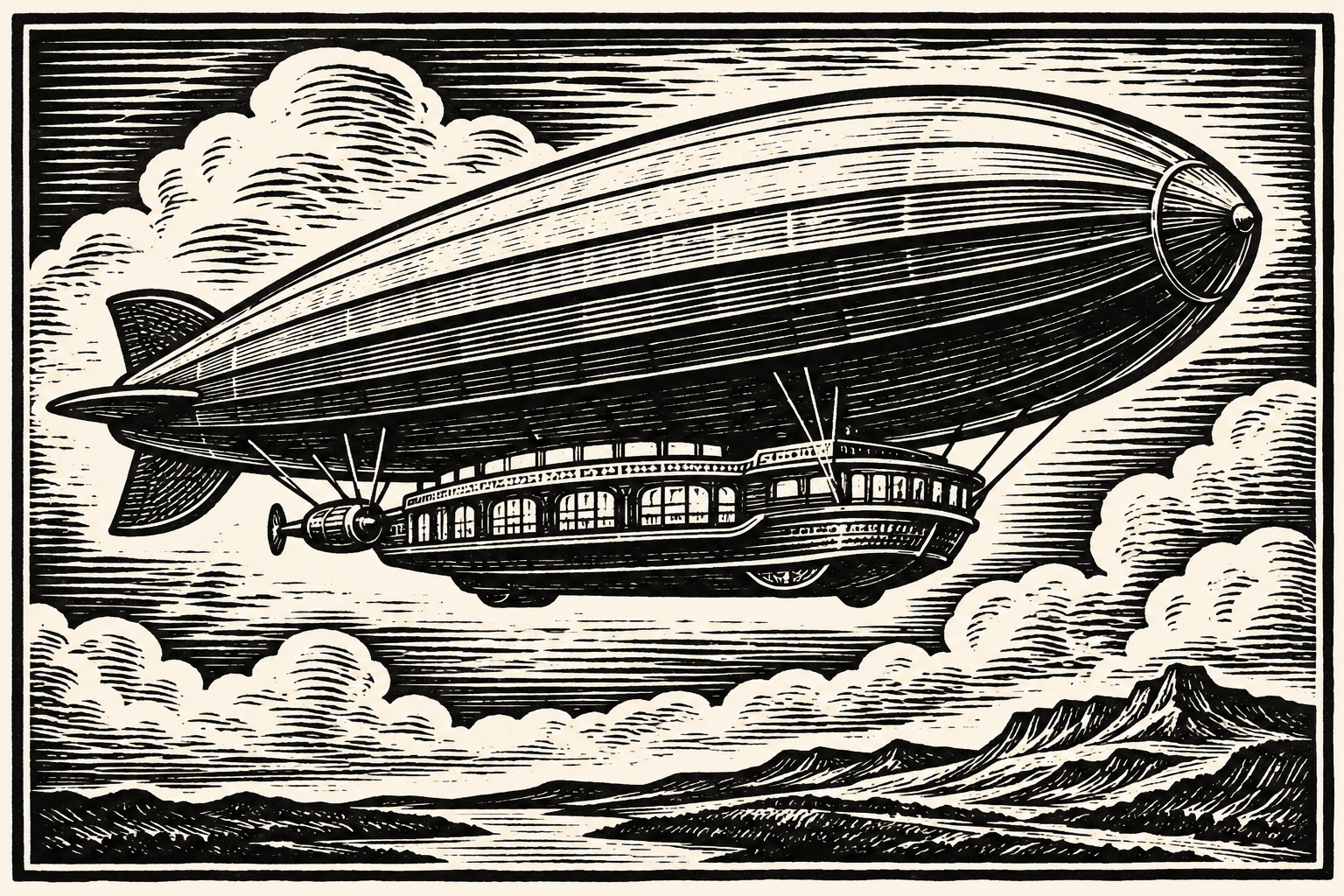
    Above him the Nordstern filled the evening sky. Eight hundred feet of silver skin. Swastikas on the tail fins. Searchlights crawled along her belly. She was the newest ship in the German fleet. She flew on hydrogen because America would not sell Germany helium.

    Hydrogen. Jack had read the newspapers in 1937. Everybody had.

    “Herr Brandt?”

    The voice was soft. Polite. Jack turned.

    The man wore a gray civilian suit that fit him like a uniform. Pale eyes. A small smile that never reached them.

    “Sturmbannführer Erich Voss,” the man said. “Security. We are responsible for the passengers’ safety on this crossing.”

    “Swell,” Jack said. “I feel safer already.”

    “You sell instruments. Gauges. Calipers. Yes?”

    “Precision instruments. Milwaukee’s finest.”

    “And you were at the docks on Tuesday, Herr Brandt? The night the Gestapo lost a prisoner by the river?”

    Jack smiled. “I was at the opera on Tuesday. Wagner. Four hours. I’d remember a dock.”

    “Would you?” Voss tipped his hat. “We will talk again. It is a long way to New York.”

    He walked off toward the gangway.

    Jack let out a breath. On Tuesday a man in a black mask had pulled a Jewish printer out of a Gestapo car by the Main River. The masked man left a snuffed match on the car’s hood. New York papers called him the Lamplighter.

    Jack had never seen the printer again. He hoped the man was in Holland by now.

    “You are nervous, young man. Everybody is nervous the first time.”

    An old man stood at his elbow. White mustache. A cardboard suitcase tied with string. He held a yellowed slip of paper in both hands like a holy relic.

    “Elias Brenner,” the old man said. “Bookkeeper. Retired. Friedrichshafen.”

    “Jack Brandt. Salesman. Not retired.”

    Brenner held up the paper. “Do you know what this is?”

    Jack squinted. It was a ticket. Printed in 1920. Luftschiff Nordstern. Friedrichshafen. Berlin. Stockholm.

    “There was another Nordstern?”

    “The first one. LZ 121. Built for the Stockholm route. I bought a ticket to go marry a Swedish girl. Ingrid.” Brenner sighed. “The ship never flew the route. In 1921 the French took her. Reparations. They renamed her Méditerranée. Scrapped in 1926.”

    “And Ingrid?”

    “The first Nordstern, young man, went to the French. Like my Ingrid’s letters, she simply stopped arriving.” He folded the ticket away. “Nineteen years I waited to fly on a Nordstern. Tonight I fly.”

    The ground crew shouted. Ropes slapped. Jack followed the old man up the gangway into the belly of the ship.


    The Chief Steward served dinner at nine.

    Consommé. Then fish. Then tenderloin on toast. The dining room ran down the whole port side of A deck. Silk paintings on the walls. White linen. Real silver.

    Jack ate and watched.

    There were thirty-one passengers. He counted. Salesmen do.

    At the far end of the lounge a woman played the piano. Lotte Krämer. Tall, dark, theatrical. She tickled the keys like they owed her money. The piano was aluminum. A Blüthner. It weighed less than a fat man and echoed like a church.

    A small man in a brown suit stood behind it. Paul Weller, piano tuner. He had a leather kit of hammers and mutes. Between Krämer’s pieces he leaned in and tightened a pin. He hummed while he worked. Mendelssohn. Jack recognized the tune. It was not a tune anybody hummed in Germany these days.

    Weller kept looking across the room. At Voss.

    Every time Voss looked back, Weller dropped his eyes.

    “Interesting man,” said the gentleman beside Jack.

    Dr. Anselm Roth. Gray beard. Chemist’s hands, stained yellow at the fingertips. He worked for IG Farben and carried a fat leather wallet he never let go of.

    “The tuner?” Jack asked.

    Roth leaned close. His voice dropped.

    “That man is not a tuner. He needs…”

    A shadow fell over the table.

    “Dr. Roth.” Voss smiled down at them. “We were hoping you would join us for a cigar. Before the smoking room closes?”

    Roth closed his mouth. He folded his napkin. He did not finish the sentence.

    “Of course, Herr Sturmbannführer.”

    Across the table, old Brenner tapped his water glass. The water sat slightly tilted.

    “You see that?” Brenner said to nobody. “She trims heavy forward. Right by the lounge. For forty years I kept books on freight. I know when something weighs more than the ledger says.”

    Nobody listened to him. Nobody ever listened to a bookkeeper.


    The smoking room was on B deck.

    It was the only place on the ship a man could light a cigarette. It was kept at higher pressure than the rest of the ship. If hydrogen ever leaked, it would be pushed out, not sucked in. You entered through a double door airlock beside a little bar. The barman watched everybody come and go.

    His name was Ernst Pohl. He was thin and gray and he counted things out loud.

    “One lighter,” he told Jack at eleven thirty. “Electric. Mounted on the wall. Nobody takes fire out of this room. Nobody.”

    “I believe you.”

    “I was at Lakehurst. May 1937. Ground crew.” Pohl wiped a glass. “Thirty six people. I counted them after.”

    Jack did not ask anything else.

    At midnight Pohl sealed the room. One passenger remained inside. Roth. He wanted one last cigar alone, he said, with the lights of the Rhine below the sealed windows.

    Pohl wrote it in his log. 24.00. Dr. Roth. Alone.

    Jack went to bed.


    At one in the morning somebody screamed.

    Jack was in the corridor in his shirtsleeves before the second scream. Passengers spilled out of fabric cabins. A steward ran past.

    The airlock stood open. Pohl stumbled out of it, both hands over his eyes.

    “My head,” he gasped. “I can’t see. Everything is dark. Everything… so small.”

    Jack caught him. Pohl’s pupils were pinpricks. Black dots in gray glass.

    Through the inner door Jack saw Roth.

    The chemist sat in a leather chair by the window. His cigar had fallen to the carpet, unlit. His eyes were open. His pupils were tiny. There was no blood. No wound. Just a faint smell in the air. Sweet. Like fruit left too long in a bowl.

    Jack started forward.

    A hand stopped him.

    “No, Herr Brandt.”

    Voss stepped past him into the room. He walked straight to the body. He bent over Roth and studied the dead man’s face. He breathed the air. He stood there a full minute.

    Nothing happened to him.

    Jack noticed that. He noticed Voss’s eyes, too, in the electric light. Wide. Black. Like a cat’s at night.

    He filed it away. He did not know yet what drawer it went in.

    The captain arrived in a dressing gown. Kapitän Albrecht Sander. Short, square, worried.

    “A heart attack,” the captain said. “Yes? An old man. A cigar.”

    “Perhaps,” Voss said. “But we will investigate, Kapitän. Quietly. Nobody must panic. Not on this ship. Not with this hydrogen over our heads.”

    “Of course.”

    “The room stays sealed. I take charge of the inquiry. On the authority of Berlin.”

    The captain nodded. He looked relieved to hand it over.

    Voss turned. His eyes found Jack.

    “Herr Brandt. You sat with Dr. Roth at dinner. He whispered to you. We saw it.”

    “He was telling me about the fish.”

    “Was he? Then you will tell us about the fish. At length.” Voss nodded to two stewards. “Herr Brandt is confined to his cabin. A guard at the door. Nobody visits him.”

    “You’re arresting me?”

    “We are protecting you,” Voss said. “Somebody aboard this ship has killed a man without leaving a mark. You were the last one he spoke to. If you are innocent, you are in danger. If you are not…”

    He shrugged.

    The stewards took Jack by the arms.

    He let them. Fighting on a hydrogen ship was a bad idea. He had a feeling it was going to come to that anyway.

    They walked him down the corridor past the dark windows. Somewhere below, the Atlantic waited.

    The door of his cabin closed. A key turned.

    Jack sat on his bunk in the dark.

    A man was dead from something nobody could see. The killer was still aboard. So was the weapon. And the only man who had tried to warn him was cooling in a sealed room above sixteen gas cells full of hydrogen.

    Jack Brandt was a prisoner.

    Somewhere on this ship was death. Only death wasn’t locked up.

    Part Two coming

    Read more: The Zepplin of Lost Souls (Part One)
  • The Spill of Sangria Blood: A Little Game of Cat and Mouse

    The Spill of Sangria Blood: A Little Game of Cat and Mouse

    [In this final part of The Spill of Sangria Blood, zoo security guard Torely Stone comes face-to-face with the killer of his best friend Tom Dantry. Of course, he’s nearly killed himself, goes on a wild chase, and finally corners the killer behind the elephant enclosure.]

    The idea of cat and mouse is for the cat to lay a trap for the mouse and wait for it to bite. Of course, it call all end up like a Tom and Jerry cartoon; too often the mouse is smarter than the cat. I felt strongly that I was the cat, but frankly, I had no clue who was the mouse.

    Of course, little details would never stop me. I had to think up a good plan and let the mouse come to me.

    I needn’t wait long. The zoo board named zoologist Amy Peters as the new zoo director and on top of it all, it announced the zoo would go ahead with Project Atlas and begin fundraising for the now named Tom Dantry Memorial Zoo Expansion. Peters had been put in charge and she wanted this whole Dantry death behind her.

    “Project Atlas is Tom Dantry’s legacy,” Peters explained to the press. “The Kokosia Zoo will become a premier research zoo here on the Central Coast.”

    I thought the zoo expansion was the perfect way to bring out the killer. Resurrect an idea Dantry died for and invite the killer to come and target another zoo director. I didn’t like the idea of feeding Amy Peters’ to the lions, but I would make sure she never faced danger.

    “You know, putting Project Atlas into play invites the killer to try again,” I warned Peters.

    “We need this solved so we can start raising money,” she offered. “Any closer to finding the killer?”

    “We had some ideas but they have all fallen through. Honestly, this might be a way of drawing them out.”

    “I’m not keen on becoming bait,” Peters stated.

    “Of course,” I replied. “I will solve this before it comes to that.”

    “Project Atlas” was the bait to draw the killer out. I didn’t relish using my friend Amy Peters as the next sacrifice, but my plan took the now real “Project Atlas” and made it a new target. If the killer wanted the plan gone, they were going to come after Peters.

    The newspaper headline announced a ‘major expansion’ to the zoo and laid out all the details of the plan. The news went through the proposed changes and how the zoo planned to raise money to pay for it.

    Amy Peters stood in the line of fire as the new zoo director and the chief cheerleader for the project. All I needed now was a mouse to come take the bait.

    After a few weeks nobody tried to kill Amy Peters and the plans for Project Atlas moved forward. It was clear to me Project Atlas was not the reason for Dantry’s death, the shooting of Miguel and Eli, and all of the endless dead ends of this case.

    It had to be something personal tied to Dantry. But what? Waters and I went through the facts again over lunch at Spinnakers.

    “Jenna Shaw made it clear Dantry was never going to leave his wife,” Winters reminded me with a mouth full of roasted turkey. He swallowed and took a long drink of sweet tea.

    “The wife never made sense to me,” I exclaimed. “Dantry was a bachelor. I never met a wife in all the years I knew him. He didn’t have one.”

    “Maybe he had a secret life,” Winters offered. “Perhaps he had several secret families hidden all over the place and one of the wives found out.”

    He was being sarcastic and the idea was preposterous. Or was it? 

    “We need to talk with Jenna Shaw again. Find out what she mean’t by Dantry having a wife.”

    I asked Carrie to invite Jenna Shaw to my office to clear the air. I wanted to shed light on her mysterious comment. Carrie went about setting the meeting.

    “Why are you meeting her here?” quizzed Carrie. “Shouldn’t this be done at the sheriff’s office?”

    “I don’t want her to think she’s a suspect. At least not yet,” I replied. “Plus, she’s aware of how things look; she will be more open if she thinks this meeting isn’t all out there for anyone to see.”

    Jenna Shaw walked into my office looking a bit disheveled and unpolished. Her usual high-end demeanor was replaced with a loose hoodie, sweats, and her hair was pulled back in a ponytail. Honestly, I thought she might be on vacation.

    “I’ve been home sick these past few days,” she announced. “And I’ve been out of the loop; the board made their press announcement about the zoo expansion without me.”

    “How do you feel about Amy Peters becoming the new zoo director?”

    “Fine, I guess,” Shaw replied. “Someone’s got to do it.”

    The phone rang and Carrie answered it though the window separating my office from the foyer. She interrupt my conversation with Shaw through the intercom. 

    “Ms. Peters would like for you to swing by her office,” she announced. Carrie went back to tidying her desk and and I turned my attention back to Shaw. “You said something interesting the other day,” I started. “You told me Dantry had a wife and he was never going to leave her for you.”

    Shaw squirmed in her seat. “I don’t want to talk about my affair with Dantry.”

    “I don’t really care about that. I am interested in Dantry’s wife,” I declared. “Did you ever meet her?”

    Shaw hesitated. “I saw them once at a charitable event. He introduced her as his wife.”

    “Really?” I still didn’t believe it. All through our friendship I only knew him as a bachelor. “What did she look like?”

    “She was a bit older than him, I think. Brunette hair cut short and red lipstick.”

    “Why did you think Dantry would never leave her?”

    “Because he told me,” Shaw exclaimed. She started to cry. “That’s why we were fighting. He told me that the affair was over.”

    Shaw’s alibi had checked out; she was having drinks with the Finkle’s after the ballet and couldn’t have killed Dantry.

    “I understand how upsetting this is,” I offered. “I’m sorry you’re going through it.”

    “Are you any closer to finding his killer?” Shaw asked.

    “No. But you’ve been helpful,” I said offering her support as she stood from the chair. 

    As we walked from my office, Carrie was gone from her desk and I found a note: “Meet me behind the elephants.” The hair on my neck stood at attention and I sensed dread. Could Carrie know something about Dantry’s death?

    The twilight sun cast eerie shadows across Carrie’s face as I caught up to her behind the empty elephant enclosure. Her eyes darted like a trapped animal’s, a cocktail of fear and defiance swirling in their depths.

    “You’re close to solving this?” she trembled and bit her lip.

    “I have a lead… thanks to Ms. Shaw.”

    “I heard you through the intercom.” She paused and went on angrily. “You have to understand…” I feared her next words. “I had to kill him.”

    She pressed her back against the concrete wall, chest heaving. Her news floored me and I felt a rush of nausea. She was agitated, and for a moment, I thought she might make a run for it. Her lips curled into a snarl.

    “He was going to leave us,” she spat. “My mother. Me. Toss us aside like scraps they feed pigs.”

    I took a step closer, careful not to spook her. “That doesn’t justify murder.”

    Carrie let out a bitter laugh that echoed off the empty cages around us. “Justify? You have no idea what that bastard put us through. The promises. The lies. Did you know he was going to marry mother?”

    Her words hit me like a punch to the gut. I’d known Dantry for years; thought I had him pegged. I never learned he was dating my sister.  Let alone marry her. Shows what I know.

    “He told mom he loved her,” Carrie continued, her voice breaking. “Said we’d be a family. Then I found the pictures of him and Jenna with a note. Jenna said she loved him.”

    I could see the hurt radiating off her in waves, mixing with a desperate anger that made the hairs on the back of my neck stand up.

    “So you decided to feed him to the lions?” I asked, unable to keep the edge from my tone.

    Carrie’s eyes flashed. “I couldn’t let him ruin our lives. You don’t understand. Mom… she wouldn’t survive being abandoned again.”

    The pieces were falling into place, forming a picture I wished I could un-see. This wasn’t just about jealousy or revenge. It was about a desperate attempt to hold a fragile world together.

    “There were other ways, Carrie,” I said, softening my voice. “Legal ways.”

    She shook her head violently. “No. He had to go. It was the only way to protect what matters.”

    As I looked at her – this young woman I’d worked alongside for months, my niece – a hollowness grew in my chest. How had I missed the storm brewing behind those eyes?

    I stared at Carrie, my mind reeling. This girl – barely out of college – had orchestrated a murder with the cold calculation of a seasoned hitman. And I’d been blind to it all, chasing after low-hanging fruit and missing the fruit in front of me.

    “It wasn’t enough to kill him, was it?” I asked, my voice gravelly. “You had to pin it on someone else.”

    Carrie’s lips curved into a smile that didn’t reach her eyes. “Eli Price was perfect,” she said, her tone chillingly matter-of-fact. “I chased him and Miguel and waited for Eli to fight back. He picked up the tranquilizer rifle and came after me.”

    “Except I showed up,” I offered. “Why did you shoot Eli?”

    “He was pretty convincing in his dumbass manner,” she snapped. “You were buying it up.”

    “Jesus, Carrie,” I muttered, running a hand through my thinning hair. “Do you have any idea what you’ve done? The lives you’ve ruined?”

    She tilted her head, eyes narrowing. “I did what I had to do. For my family.”

    Family. The word hit me like a sucker punch. My sister’s face flashed through my mind. What would this do to her? 

    “There’s always a choice,” I said, more to myself than to her. “Always.”

    Carrie’s laugh was sharp and bitter. “Easy for you to say. You’ve never had to fight for every scrap of happiness you get.”

    I reflected on her words. I was fighting my whole career and bumping up against a wall. Now, I had another wall to face.

    The weight of my badge hung heavy – metaphorical now, but no less weighted – pressing down on me. Duty warred with self-preservation, and I understood whatever I chose next would change everything.

    I reached over to comfort her, a gesture of support for family. Carrie pulled back. I watched her carefully, my old cop instincts kicking into high gear. Her eyes darted left and right, seeking an escape route. 

    “Carrie,” I said, keeping my voice deep and steady, “let’s talk this through. There’s still a way—”

    She bolted. 

    One second she was there, the next she was a blur of movement, darting between the shadowy animal enclosures.

    “Carrie!” I shouted, my feet already pounding the pavement after her. “Stop!”

    My lungs burned as I sprinted down the dim path. When did I get so old? The zoo was a maze of twisting walkways and looming exhibits. Somewhere, a monkey shrieked, as if mocking my wheezing pursuit.

    “This isn’t going to end well for anyone!” I called out, rounding a corner. My knees creaked in protest. “Just stop and we can figure this out!”

    The path ahead forked, and I hesitated for a split second. Left or right? In that moment of indecision, Carrie vanished like a magician’s assistant.

    “Shit,” I muttered, choosing left on instinct.

    My footsteps echoed off concrete as I ran past empty food stalls and shuttered gift shops. The air was thick with the musky scent of animals and the cloying sweetness of popcorn gone stale. It was like chasing a ghost through a carnival funhouse.

    I slowed to a jog, straining my ears. The zoo had gone eerily quiet, as if every creature was holding its breath, watching the human drama unfold. My heart thundered in my chest, drowning out any subtle sounds that might betray Carrie’s location.

    “Come on, Carrie,” I called out, my voice echoing in the empty zoo. “Let’s not drag this out. Neither of us wants to spend the night playing hide and seek with the lemurs.”

    Silence answered me. I took a cautious step forward, every sense on high alert. The stakes were too high for mistakes. One wrong move and this whole situation could turn into lion show without a tamer.

    As I inched forward, I couldn’t help but think: when did my life become a bad episode of Wild Kingdom meets Law & Order?

    A flicker of movement caught my eye; a shadow darting between the elephant enclosure and the reptile house. Bingo.

    Rounding the corner, I caught sight of her silhouette in the moonlight. She was running full tilt, her blonde hair streaming behind her like a comet’s tail.

    “Stop!” I yelled.

    Then luck intervened and Carrie hit a patch of water leftover from the nightly cleanup. She slipped and fell headfirst into a wall. I caught up with her, rolling once before coming to a stop. I found myself face-to-face with my niece, her eyes wide with a mixture of fear and defiance.

    I reached for my gun and raised it.

    “I don’t want to shoot you,” I exclaimed, begging her to give up. “But I will if you run again.”

    She stared at me, breathing heavily, and looking like a cornered cat.

    “Carrie,” I said, trying to keep my voice steady, “you know I have to turn you in.”

    The words hung in the air between us, heavy with implication. I could feel the conflict raging inside me. On one hand, justice demanded that Carrie face consequences for her actions. On the other, the scandal would tear my family apart. My sister would be devastated; her daughter at the center of a murder.

    Carrie must have sensed my hesitation. “Please, Uncle” she pleaded, her eyes brimming with tears. “You can let me go. We can forget this ever happened.”

    For a moment—just a moment—I considered it. Then I thought of Dantry. His life snuffed out because of her actions. I thought of Miguel and Eli, one nearly dead and the other nearly framed for murder.

    With a heavy sigh, I reached for my phone. “I’m sorry, kid,” I said, dialing the number from memory. “Some things are bigger than family.”

    As I waited for the call to connect, I caught Carrie’s eye. There was no anger there anymore, just a resigned sadness. I felt it mirrored in my own heart.

    “This is Stone,” I said when the dispatcher picked up. “I need officers at the zoo. I’ve got a suspect in custody for the murder of Tom Dantry.”

    The flashing blue and red lights pierced the darkness, casting eerie shadows across the zoo’s deserted pathways. I watched as two officers led Carrie away, her head bowed and shoulders slumped. A cocktail of emotions churned in my gut—relief that justice would be served, sadness for the mess we’d all have to wade through.

    “You did the right thing, Stone,” Detective Winters said, clapping me on the shoulder.

    I nodded, my throat too tight for words. As the patrol car pulled away, I muttered, “Doesn’t make it any better.”

    With the excitement dying down, the zoo settled into an unsettling quiet. I found myself wandering the empty pathways, the events of the night replaying in my mind like some twisted highlight reel.

    Passing the warthog exhibit, I chuckled darkly. “At least you fellas get three squares and bars between you and your problems.”

    The horned pigs ignored me, probably used to the ramblings of night guards and zookeepers.

    I paused by the elephant habitat, leaning against the railing. “What a goddamn mess,” I sighed, rubbing my face. “How the hell am I gonna explain this to Mary?”

    The thought of my sister learning about Carrie’s involvement; it made my stomach turn. But as I stood there, surrounded by the ambient sounds of nocturnal animals, a strange sense of calm washed over me.

    “One step at a time, old man,” I told myself, pushing off the railing. “You’ve weathered worse storms.”

    As I made my way towards the exit, I couldn’t help but feel like I was leaving more than just a case behind. A chapter of my life was closing, but damned if I knew what the next one would bring.

    I stopped at the zoo’s main gate, my hand resting on the cold metal, then turned to face the darkened zoo, its silhouette a reminder of the twists and turns this case had taken. 

    I thought about how I had landed here, the ups and downs of my career and the challenges of remaining relevant in a world that forgot about you about as fast as a speeding mustang. The cool night air filled my lungs as I took a deep breath. I couldn’t help but chuckle, a mix of exhaustion and dark humor coloring my thoughts.

    “Maybe,” I mused aloud, “this is exactly what I needed. A kick in the pants from the universe.”

    As I spoke the words, I felt a familiar fire ignite in my gut. It was the same determination that had driven me through countless cases, the unwavering resolve that had defined my career as a cop and now as the head of zoo security.

    As the first hints of dawn began to color the sky, I straightened up, rolling my shoulders. I turned back to face the darkened zoo, its silhouette a reminder of the twists and turns this case had taken. “Whatever comes next,” I said aloud, my voice firm, “I’ll face it head-on. No backing down now.”

    For the first time in years, I felt truly alive. Ready to face whatever came next.

    “Hell, maybe I’ll write a book. ‘The Day the Zoo Went Wild: A Memoir by Torely Stone, the Zoo Detective.’”

    As I walked to my car, each step felt like a step towards a new chapter. The road ahead was uncertain, but I was ready to navigate it with the same grit and integrity that had brought me this far.

    “Time to face the music,” I said, starting the engine. “And hope it’s not a sad funeral march.”

    With one last glance at the zoo in my rearview mirror, I pulled away, ready to write the next page of this unpredictable story called life.

    The End
    Read more: The Spill of Sangria Blood: A Little Game of Cat and Mouse
  • Shattered Echoes in a Shadow Prism

    Shattered Echoes in a Shadow Prism

    [This is a new novella, titled Shattered Echoes in a Shadow Prism, about a marketing executive who finds she has been missing for a month. This will likely be published under a pen name. This is part one setting up the mystery.]

    Part One: Why Does Everyone Think I’m on a Milk Carton?

    Sarah Lane jolted awake, her head throbbing with a pricked and relentless ache—one that hinted at a night of tequila shots and hazy decisions she couldn’t quite remember. Sarah tried, but a haze muddled her thoughts. 

    She stretched and realized she was in her pink nightie, the fabric clinging unceremoniously as she sat up. Sarah reached across the bed and found herself alone. No sweet reason for my pounding headache, she thought.  What kind of party was that?

    She cradled her head, wishing the sunlight wasn’t so harsh. The sounds of the city drifted up from the sidewalk—horns blaring and voices buzzing—with the rush of morning pursuits and commutes to work. Sally’s throbbing head rang like a bell.

    A director of social marketing at The Grey Agency, Sarah was used to promoting tremendous parties her clients hosted. Sarah smiled at the thought this must have been one hell of an event.

    She reached for her phone; the time 6:46 and the date November 10. That’s not right; it’s only October 10! Why on Earth was the calendar off a month? Sarah scrolled through her texts. More and more they read like a missing person’s blog. “Where are you? Are you okay? We have that Helmsted meeting; will you be there?” 

    Why is everyone acting like I’m on a milk carton? Leave it to Ted Helmsted, the actor and game show host, to come up with such an elaborate joke. Sarah chuckled at the thought. 

    The messages became frantic, with the final message curt. “You are close to being fired. Contact me now,” from Mark Willis, the vice president of marketing and her boss. 

    Sarah started to call, then thought better of it. “I should face him,” she reasoned. If this is a prank, then he may be anticipating my surprised face. At least she hoped so.

    The ride to the 32nd Floor was slow with frequent stops and riders jostling in the elbow-to-elbow vault. Soon the crowded elevator emptied and she stood alone as the doors opened. The lobby was decorated for Thanksgiving, with paper turkeys rounding the reception desk and fall leaves attached to the back of the monitors. 

    In the far corner, a vibrant cornucopia overflowed with a dazzling array of rainbow-hued ears of corn, plump squash, and round pie pumpkins, creating a vivid tapestry of autumn’s bounty that demanded attention.

    “Ms. Lane?” the receptionist appeared shocked. “What a surprise.”

    Two of Sarah’s friends rushed over to her, their faces filled with concern. ‘We were so worried!’ Lucy exclaimed breathlessly, as Donna wrapped her in a warm hug. They were too committed to this prank, and Sarah decided to play along with a knowing smile.

      “Is she new? I don’t recognize her.”

      “That’s Lori, silly. She started last month right before you vanished,” Donna offered. “Lori’s been as concerned as we have been.”

    “We thought you were dead,” whispered Lucy.

    “What do you mean… dead?”

    People walked by whispering. Sarah overheard “Where has she been” and “I hope she’s okay” as their worry met her confusion. She peered farther into the office suite and recognized a familiar face twisted in anger. 

    “Ms. Lane,” barked her boss Mark Willis. “We need to talk.”

      Still thinking this was only a prank, Sarah’s eyes followed her boss as he paced in front of the window overlooking the expanse of the city.

      “You’ve been gone a month,” Mark shouted “I ought to fire you!”

    “Right… I’m sure you missed me,” Sarah mocked in a sarcastic tone.

    Mark frowned. “We’ve been worried. We even called the police. No one has seen or talked with you for a month.”

     “What do you mean?” Sarah exclaimed in confusion. Her head throbbed more than before. “I don’t understand… ” The more she thought about it, the more her head rang. Sarah pressed on her forehead.

    “I mean… you’ve missed work for a month.” Willis barked. “Have you been sick? On a bender? Being a flake?” Willis asked in rapid succession without waiting or expecting an answer. He paced back to the window.

    “You must believe Sarah, I think the world of you and I promised your mom to protect you.” His tone softened. “But it’s damn hard to do that when you won’t return my messages, take my calls, or come to work.”

    Mark Willis was more than Sarah’s boss; he was also her uncle.

    “Your absence almost cost us the Helmsted account,” Willis stated. “Ted Helmsted doesn’t understand why his personal social media manager went missing. Good thing I covered.”

    Realizing her boss was sincere, Sarah’s voice trembled tinged with hestitation. “I… I’m confused. I guess I’ve lost time,” she murmured, pressing her fingers to her temple as the ache in her head deepened. Sarah faced Mark, her eyes clouded. “Everything’s… a blur.”

    Read more: Shattered Echoes in a Shadow Prism
  • The Spill of Sangria Blood: Dances With The Devil

    Part Three: The Spill of Sangria Blood

    (Torely Stone continues to investigate the death of Tom Dantry by interviewing suspects Jenna Shaw and Rachel Holt. He also comes face-to-face with the killer and pays the price as he dances with the devil in the third part of the novella The Spill of Sangria Blood.)

    Dances with the devil

    The Kokosia Zoo was a sensory overload on this balmy Saturday afternoon. A discord of shrieks—both human and animal—assaulted my ears as I shuffled away from Spinnakers in the middle of the zoo. My nostrils were assaulted by the pungent cocktail of sunscreen, cotton candy, and eau de elephant dung. 

    Everywhere I looked a veritable menagerie of humanity that rivaled the actual zoo inhabitants. Frazzled moms pushed strollers like battering rams, their exhausted expressions a stark contrast to their spawn’s sugar-fueled mania. I narrowly dodged a sticky-fingered toddler on a rampage, his harried mother in hot pursuit.

    “Trevor, no! We do not lick the penguin enclosure!” 

    I snorted, earning a dirty look from Trevor’s mom. Sorry, lady. Your kid’s probably building immunity or something.

    As I meandered past the flamingo pond, I saw a gaggle of single men prowling the pathways. They strutted about like peacocks, eyes darting from animal exhibits to any female that looked vaguely unattached. One bold specimen sidled up to a young woman peering at the warthogs.

    “Hey there. You really like those little guys. Wanna grab a coffee and talk about… warthogs?”

    I cringed at the awkward pickup attempt. The woman’s polite but firm rejection was almost drowned out by a nearby lion’s well-timed roar. 

    Oh to be young and stupid again, I thought to myself. After all my experiences, I still was trying to prove something. I emphasized with the guy and thought about my own bad timings. A lot of failures, with the end of my sheriff career at the top of them. Why is it that no matter all the good you do, you’re only remembered for the failures?

    Dantry’s death had me back in the thick of things. Maybe solving this would land me into real police work? So far, I had no clue about the killer, but “Project Atlas” was pointing me to a motive. What was Dantry hiding and who was involved?

    Jenna was a possibility and so was Rachel Holt. But just because they were women, didn’t mean they weren’t involved. I needed to go over that list in the “Project Atlas” folder. As soon as Winters’ searched Dantry’s office and put it into evidence.

    The lush vegetation lining the walkways provided a brief respite from the my thoughts about the case. I paused beneath a towering eucalyptus, its distinctive aroma mingling with the salty tang of the nearby Pacific. A gentle breeze carried the scent of blooming jasmine, a stark contrast to the earthy musk emanating from the primate enclosures.

    As I continued my walk through the zoo, with its mix of humanity and nature, I couldn’t help thinking that the peacefulness was a far cry from the events of last night. And I wondered if things had settled down or if more monkey business was on the way.

    Winters and crime scene techs were going through Dantry’s office when I showed up to make sure he’d secured the “Project Atlas” folder. He waived for me to join him. Jenna Shaw also was in the room rocking in place and holding a brown day planner.

    “Jenna has something that ties you to Dantry,” Winters reached for the planner. He pointed to an entry. “Looks like you and Dantry were going to meet regarding Project Atlas.”

    I read the entry for myself: “Meet Stone. Discuss Atlas termination.”

    “I have no idea,” I handed back the planner to Winters. “Maybe he planned to bring me into the loop.”

    “Jenna thinks you met with Dantry and didn’t like what he told you. Gives you a motive,” Winters intimated and Jenna agreed by nodding.

    “First off, me and Dantry would have to meet, which didn’t happen. And secondly, I was drinking mojitos when he was killed.” 

    After being shot at and chasing the killer, I was in no mood for Winters’ acting like a jackass. “Let’s go down this safari trail; a better question to ask is where were you Ms. Shaw?”

    Jenna Shaw turned white. “I was home… I went to bed… I had nothing to do with the murder!”

    “You told me Dantry and you were in a relationship.” I threw that little tidbit out to turn the table. Shaw turned fuming mad and beet red.

    “I told you that in confidence,” she shrieked. “You had no right!”

    “I suppose you can provide an alibi for the time of Dantry’s death?” Winters scrutinized Jenna’s face waiting for an answer.

    “Just what I told you: I was home.”

    “My assistant Carrie can back me up on my schedule and whether I met with Dantry or not.” I offered. ”Which sounds a whole lot more than what you’ve got Ms. Shaw.”

    “Dantry came over… and we had a fight. But I didn’t kill him!” Shaw insisted.

    “Sounds like you had motive Ms Shaw.” I caught Winters’ eye and he nodded.

    Jenna Shaw glared at me with the penetrating eyes of a cobra. Winters handcuffed her arms behind her back and led her out of the office. At last we had someone who might have the means for Dantry’s death. If we had motive, was another story. We had to find out the answers when Winters questioned Ms. Shaw.

    After I left Dantry’s office, I wandered down to see Rachel Holt. The head veterinarian was readying to leave her office.

    “Mind if we talk?”

    Dr. Holt’s fingers were fidgeting with the stethoscope around her neck, her eyes darting around the room like a caged animal looking for escape.

      “Dr. Holt,” I said, my voice cutting through the tension. “You and Dantry had some disagreements recently, didn’t you?”

      Rachel’s head snapped up, her eyes meeting mine. “I… we had professional differences, yes.”

      “Professional differences?” I echoed, raising an eyebrow. “Would these ‘differences’ have anything to do with an expansion of the zoo?”

      The color drained from Rachel’s face faster than water from a leaky bucket. “How did you-“

      “I’m head of security, doc. It’s my job to know things.” I leaned in, lowering my voice. “Now, why don’t you tell me what’s really going on?”

      Rachel’s shoulders slumped. “Dantry… his expansion plan focused on breeding endangered species without regard for genetic diversity. It was all about profit, not conservation. I couldn’t stand for it.”

      “Project Atlas was just a plan, right?” I offered to Dr. Holt. She was puzzled.

      “Is that what he was calling it? I never heard the name. He only told me about his plan a few weeks ago.”

      Either she knew more than she was saying about “Project Atlas” or she was clueless. I nodded, filing away the information. Dr. Holt might be hiding something, but her passion was genuine.

      Dr. Holt’s assistant rushed into the office. “We need you. A giraffe is hurt.” Without saying goodbye, Dr. Holt left faster than a gazelle.

      No matter. Winters returned and I caught up on the attack at the Chimpanzee House. Three people stood out; Eli, Miguel, and the fast fellow who led me on a chase all over the zoo before vanishing.

      “Miguel’s going to live and Eli needed some stitches,” Winters said.

      “Why were they hanging out with the chimps?”

      “Turns out they were doing some sleuthing on their own,” Winters explained. “They recognized arguing and thought it might be the murderer.” 

      “And the dart guns?”

      “Eli says he grabbed one in the veterinary office behind the chimps for protection,” Winters stated. “Sounds like they needed it.”

      I pondered what Winters told me.

      “We aren’t any closer to solving this.”

      “Well, maybe Ms. Shaw can fill in some cracks.”

      Jenna Shaw sat alone in the interrogation room as Winters wandered in with the “Project Atlas” folder and a cup of coffee. He offered the cup to her as I watched them through the observation window.

      “Do you want an attorney?” he asked.

      “No. Nothing I say will connect me to Dantry’s murder.”

      Winters started with some basic questions that led to Shaw’s fight with Dantry.

      “What was the fight about?” Winters quizzed Shaw who tapped her fingers on the metal table. She offered nothing.

      “Let’s talk about Project Atlas, shall we?”

      A sharp intake of breath.

      “I don’t recognize what you’re talking about,” she replied, her voice wavering.

      Winters chuckled darkly. “Cut the crap, sweetheart. You and Dantry were more than just colleagues, weren’t you? What got you so mad you killed him for it?”

      “I didn’t kill him. Although I wanted to.” Shaw shouted. “He was never going to leave his wife… so I ended it.”

      That didn’t make sense. Dantry was a bachelor. I was sure of it.

      “You sound like a woman scorned,” Winters scoffed. “I suppose you’re going to tell me now you just amicably ended it?”

      “Yes. And then he left.” Shaw replied. “We were supposed to go to the ballet. I still had the tickets, so I went alone.”

      This was new information and took the wind out of my sails.

      “You can prove you went to the ballet?” demanded Winters.

      “I met up with Dr. Finkle and his wife Mary. We stayed for the performance and then had drinks. I didn’t get home until after 1.”

      Winters left the interrogation room and I met him in the hallway.

      “If the Finkle’s confirm she was with them, she has an alibi.” Winters declared. “With an alibi we’re back to square one.”

      “Listen, Dantry was a bachelor,” I pressed. “So, I can’t figure out this mysterious wife.”

      Winters shrugged and went into the interrogation room to release her.

      As I stood alone in the hallway, all I could think about was we were at the beginning. All we had was a folder covered in lipstick and perfume, and two female suspects who looked like they didn’t do it. 

      Shaw had said she and Dantry were having an affair and he wasn’t going to leave his wife. My friend Dantry was a bachelor, so Shaw related another thing that didn’t make any sense. The only thing that did make sense was Dantry was dead and we were no closer to pinning the killer. 

    The sheriff’s office was nothing like I remembered; it was cleaner and modern. The waiting area resembled a hotel lobby. The walls, once adorned with the weathered faces of sheriffs past, now gleamed with sterile white paint. A single photo hung in solitary splendor – an official-looking photo of Sheriff Shelton. All the deputies behind the counter were new and no one recognized me. So much for legacy; no one would pat me on the back if they wanted to.

    I absently pushed through the glass doors into the bright afternoon sun. The courthouse square spread out before me, a patchwork of old and new. The sandwich shop where I’d spent countless lunch breaks still stood, but now it was flanked by a trendy coffee bar and a vegan bakery. Next to them was the park where I often ate my sandwich. 

    Uneven brick paver stones made up the streets around the courthouse square and they were just as worn. I took it all in; lawyers, defendants, and family walked around me conducting business with the county. I couldn’t help but think; they all were animals out on furlough waiting to be put back in their cages.

    “Speaking of cages,” I laughed to myself. “I’d better get back to mine.” I stepped off the curb and reached for my fob to enter the car. 

      That’s when I sensed it – a faint whistle cutting through the air. Before I could react, something pinged off the car roof. A dart clattered to the sidewalk, its needle glinting in the sunlight. Stunned pedestrians quickly moved away. I turned in the direction of the shooter. I didn’t see anyone except a line of people in front of the sandwich shop. 

      I dropped to the ground, my aging knees protesting. Another dart whizzed past, lodging itself between the car’s window and door frame.

      “What the hell?” I growled, scanning the rooftops for the unseen assailant.

      My heart pounded in my chest as I army-crawled to a nearby planter. The paver bricks bit into my palms, a grim reminder that I was too old for this crap.

    I ducked close to the paver bricks. They were warm. That’s my last full memory as a sharp sting bloomed between my shoulder blades. The warmth spread out across my body as the sedative dribbled from the tip of the dart. Heat waves billowed up around me.

      “Ah, shi-” I managed to slur before darkness claimed me, leaving me sprawled ungracefully in front of the courthouse like a discarded mannequin.

    I groaned and pried my eyelids open, faced with sterile beige walls closing in around me. My head felt like it had been stuffed with cotton and then run over by a steamroller. My tongue was fuzzy and swollen as if I had swallowed a kiwi. Blinking away the fog, I made out three figures hovering over me: Winters’ craggy face, Carrie’s concerned frown, and… wait, was that Mary?

      “What the hell?” I croaked, my voice raspy. “Sis, what are you doing here?”

      Mary leaned in, her familiar scent of lavender and worry washing over me. “Oh, Torely. Thank God you’re awake. I came as soon as Carrie called me.”

      I tried to sit up, but my limbs fell like lead weights. “Heard what? Last thing I remember, I was…” The memory slipped away like sand through my fingers.

      Carrie placed a gentle hand on my arm. “You were hit with a tranquilizer dart. You’ve been out cold for hours.”

      “Jesus,” I muttered. “Someone’s taking this game of darts way too seriously.”

      Winters stepped forward, his face grim. “This is no game, Stone. The killer is closing in, and they want you six feet under.”

      I attempted a sardonic laugh, but it came out more like a wheeze. “Well, aren’t I the popular one? And here I thought my charm was wearing off.”

      Mary’s eyes welled up with tears. “Torely, please. This isn’t funny. You need to let the police handle this investigation before it’s too late.”

      I took a deep breath, wincing at the dull ache in my back where the tranquilizer dart had struck. “Look, the fact that someone’s trying to take me out means I must be close to cracking this case. They want me dead because I’m a threat.”

      Carrie’s eyebrows knitted together, her usual cool demeanor cracking. “That’s not exactly comforting, boss. You’re not invincible.”

      “Trust me, I’m well aware,” I muttered, gesturing to my current state. “But think about it. Why go to all this trouble if I wasn’t onto something?”

      Winters crossed his arms, his weathered face a mask of concern. “It’s a hell of a risk you’re taking, Stone. We can’t even tell who we’re up against.”

      I managed a wry smile. “That’s the thing about mysteries, detective. You don’t know until you do.”

      Mary grabbed my hand, her grip tight. “Torely, please. Find another way.”

      I squeezed her hand back, my throat tightening. “I wish I could, sis. But sometimes, you’ve got to dance with the devil to catch him.”

      The room fell silent again, tension thick enough to cut with a knife. I could feel their worry, their fear. Part of me wanted to give in, to walk away and leave this godforsaken case behind. But I knew I couldn’t. Not when I was this close to unmasking a killer.

      “So,” I said, mustering as much bravado as I could, “who’s up for a little game of cat and mouse?” Though I was not entirely sure which one I was at this point.

    (Part 4 Coming November 7, 2024)

    Read more: The Spill of Sangria Blood: Dances With The Devil
  • Garbage In, Garbage Out

    What are the odds it can become #autonomous?
    Well, it is a garbage can.
    Sure, but it has Bluetooth, right?
    Only so it can talk to the refrigerator.
    Why?
    To keep track of the leftovers.

    Read more: Garbage In, Garbage Out
  • Dirty Politics

    Dirty Politics

    “My opponent is a liar. And I approve this message.”

    “What do we know about this guy?”

    “Nothing much. He does know a liar when he sees one.”

    “How do we know he’s not lying.”

    “Why would he?”

    “Because his opponent says he’s a liar.”

    “Is it possible they are both lying?”

    “Maybe that’s how you know it’s dirty politics.”

    Read more: Dirty Politics
  • The Spill of Sangria Blood: As Ornamental As a One-legged Flamingo. 

    [Following the murder in the zoo, Torely Stone faces new questions and an attempt on his life. He comes close to chasing down the murderer, but must settle of finding an important clue. Oh, and, someone threatens to kill him for good in Part 2 of The Spill of Sangria Blood.]

    Murder in the Zoo

    Eli and I moved as fast as he could shuffle to the lion’s enclosure. The zoo was quiet except for the loud crash, the nocturnal sounds of animals moving about and chittering, and the crowded group of crime scene techs, EMS, and police standing around where Tom Dantry’s body was found.

    “What was that crash?” I pulled aside the first crime tech I found.

    “Oh nothing,” she sheepishly replied. “One of the lions roared and Fred knocked over the body.”

    Other techs were scrambling to put Dantry on the gurney so he could go to the morgue.

    Eli was bleeding bad from his shoulder. “You’d better get a bandage over here,” I pushed Eli closer and took his air rifle. “You’d also better send someone over to the chimpanzee house; another zoo keeper down.”

    “So they forced you to retire,” Detective Winters stood behind me balanced like a cobra ready to strike. He brought up a painful memory.

    I sized him up. “Been talking to my past I see. Who told you? Sheriff Shelton or someone else?”

    “My boss says you’re a crook and you shouldn’t be anywhere near this investigation.”

    The last year I was sheriff something went down ensuring I retired. An election year, I should have been a shoo-in for the job. I was well-liked by the people and the politicians. Heck, I could kiss babies and woo old ladies on the campaign trail with equal results. I was the Diablo Valley Sheriff and could do no wrong.

    It turns out popularity only takes you so far and you can do wrong if you’re unlucky. Dirty tricks can end your political career fairly fast. The sheriff oversees the jail, all of the patrol deputies, the detectives, and the various general service employees. It is a big job with a lot of pokers in the fire.

    One of those pokers got too hot and I was too busy kissing babies to notice.

    The commissary fund at the jail came up empty; a total of $15,000 short. This was money the inmates had in escrow. Family and friends had scraped together what they could to make an inmate’s life better. And I couldn’t figure out how the money was gone. Sure, it was likely an accounting error but we never figured it out before the election. 

    And the press had a field day. They called me any name that stuck; crook, embezzler, bad manager. They said it all and soon I was on the outs. Not even old ladies liked me.

    I lost the election and the county allowed me retire. I took the job at the city zoo as a way to stay in police work. Although writing tickets for errant dogs doesn’t exactly count as serious policing. It was a huge leap downward, but I still could carry a gun and keep my dignity intact.

    More than 12 years I had worked with Tom Dantry at the zoo and nothing had gone wrong. In fact, moms now let me kiss their babies and old ladies seemed to like me again. I was the head of zoo security and could do no wrong.

    Winters had two deputies escort me out of the zoo. They watched me leave as I strode across the parking lot. My mind raced about the night’s events; the weight of Dantry’s death, the attack near the chimpanzee house, and the discovery of the note in Dantry’s pocked. I fingered it again. No, I hadn’t said a word to Winters about the note. It was my “get of off jail free card” and I intended to use it later.

     I fumbled for my car keys, eager to jut get home and think about what “Project Atlas” could mean in the safety of my own home. As I reached the car, a white slip of paper tucked under the windshield wiper caught my eye.

    “Probably a note from Carrie,” I muttered, snatching the paper. But my blood ran cold as I read the typed message:

    DROP THE INVESTIGATION NOW. NEXT TIME, I WON’T MISS.

    My jaw clenched. Doubtful this was from my assistant. Or was it? I started to second guess the whole evening. I crumpled the note in my fist, scanning the parking lot for any sign of the threat’s source. The only people in the parking lot were the two deputies waiting to make sure I left the zoo. Whoever typed the note was long gone.

    “Dammit,” I growled, unlocking the car and sliding into the driver’s seat. My heart pounded as I gripped the steering wheel. “I’m getting too close. They’re scared.”

    My thoughts turned to Miguel Serrano, the zoo’s maintenance supervisor. Miguel had seemed agitated when he was with everyone and said he was glad Dantry was dead. But he got the worse end of the attack at the chimpanzee house. In fact, Serrano thought Eli had shot him. That wasn’t the case, but still.

    “Miguel could be in on this,” I mused aloud. “Or… he could be another victim.”

    I peeled out and headed for the driveway to the back of the zoo. I needed to know more about who killed Dantry, who was trying to kill me, and what any of this had to do with “Project Atlas.”

    As I drove up the driveway behind the administration offices, my mind wandered to Jenna Shaw. Where did she fit into this circus of suspects? Little did I know, at that very moment, she was embarking on her own covert mission.

    Jenna’s heart pounded like a caffeinated woodpecker as she slipped into Dantry’s office. The room still reeked of his cologne – a scent that now made her want to vomit or set something on fire. Preferably both.

    “Think, Jenna,” she muttered, rifling through desk drawers. “What would make Stone look guilty as sin?”

    Her trembling hands found a leather-bound planner. Flipping through it, her eyes widened. Scrawled on today’s date: “Meet S. Discuss Atlas termination.”

    A wicked grin spread across her face. With a few strokes of her pen, “S” became “Stone,” and her path to freedom seemed clearer. All she had to do now was ensure this damning evidence found its way to the right hands.

    Jena looked around the office. The smell, the souvenirs, the memories of Dantry and their moments together startled her, making her sick. She thrashed out at Dantry and threw papers and folders around the room; really trashed the office. “You bastard!,” she screamed. “How dare you cut me out.” She cried and looked around the room where everything was tossed. A piece of paper floated to the floor. She sighed, then quietly crept out, clutching her ill-gotten prize.

    Jenna felt a twinge of guilt for framing Torely Stone. But it vanished faster than a lion’s steak dinner. In this concrete jungle, it was eat or be eaten. And Jenna Shaw had no intention of ending up as anyone’s prey.

    I turned off the car and the headlights, then coasted behind Dantry’s office. I jimmied the lock and made my way down the corridor, my footsteps echoing as I approached Dantry’s door. It was ajar, a sliver of darkness inviting me in. I hesitated, my hand hovering over the handle.

    “This feels wrong,” I whispered to myself, “but it’s the only way to get answers.”

    I clicked on my flashlight and made my way to his desk. The place looked like a tornado had hit a paper factory. Drawers hung open, their contents strewn across the floor. The computer lay in pieces, its innards gutted. Even the potted ficus in the corner hadn’t been spared, its soil spilled across the carpet like diarrhea from a nervous elephant.

    “Well, damn,” I muttered, kicking aside a crumpled memo. “Looks like I’m not the only one playing detective.”

    My eyes darted around the chaos, searching for anything that might scream “Project Atlas.” But whoever had ransacked this joint knew what they were after. The realization hit me like a tranq dart to the head – I wasn’t just solving a murder anymore. I was in a race against an unknown adversary.

    Still, it didn’t hurt to look. My investigator’s instincts kicked into high gear. I began rifling through drawers, my eyes scanning for anything out of place.

    “Come on, Dantry,” I thought. “What were you hiding?”

    As I pulled out the bottom drawer of the file cabinet, a folder caught my eye. “Project Atlas,” I read aloud, my heart racing. The folder smelled sweet like flowers and a smudge of lipstick was on the cover. Inside, I found detailed plans for a massive zoo expansion, complete with endangered species acquisitions and hefty financial projections.

    I furrowed my brow. “This doesn’t add up. Why keep this a secret?”

    I continued reading, my eyes widening as I stumbled upon a list of questionable investors and potential legal loopholes. “Jesus, Dantry. What did you get yourself into?”

    A sudden creak outside the office made me freeze. I held my breath, listening intently. After a moment of silence, I relaxed slightly, but a new tension gripped me. Someone else had been here, looking for these same documents. 

    “I’m not alone in this,” I realized, a chill running down my spine. “Whoever killed Dantry might still be here, watching, waiting.”

    I carefully replaced the folder under the bottom drawer, making sure everything appeared untouched. As I moved towards the door, I couldn’t shake the feeling of eyes on my back. 

    “I need to be more careful,” I thought, my hand instinctively moving to my gun. “This just got a lot more dangerous than I bargained for.”

    I went home and tried to sleep; the adrenaline burning low after working all day and running all night. I fell exhausted on the couch.

    My brain woke me at 6:21 a.m. urging me to piss. I swear my bladder needs more attention than a dozen puppies. I pulled myself together and splashed water on my face. A three-hour nap would have to do; I needed to get back to finding out who killed Tom Dantry and who was after me.

    I phoned and asked Winters to meet me at a local coffee shop. He wasn’t real pleased to hear from me this early. He spent the whole night up too.

    “I thought I told you we didn’t need your help,” barked Winters. He sounded irritated and groggy as if I rustled him from a good dream. 

    “Yes, that’s what you said,” sounding too pleasant in agreeing with him. “But, I need to give you some evidence I found. It could lead to the killer.”

    “Why didn’t just give it up last night?” Winters growled.

    “A lot happened,” I sighed pouring on the sarcasm. “And it just didn’t make the top of my list of concerns… Let’s meet and I’ll fill you in.” If I was going to hand over the note, I wanted to get something in return.

    “Fine.”

    I found Winters eating a plate of eggs and slurping from a thick white cup of coffee in the corner booth. He wasn’t happy to see me.

    “The sooner you are out my sight, the better.”

    I slid into booth facing him and reached for his toast. 

    “I don’t know what the new sheriff told you, but you need me on this case.” I flashed him a smile as big as a Cheshire cat; I had a secret and he was going to have to wait.

    “He told me about the missing money. You’re a crook,” scowled Winters.

    I took a bite of the bread.

    “Did he tell you the money mysteriously appeared as soon as he was elected?” I leaned forward. “It was an accounting error like I thought and Sheriff Shelton got to play hero.”

    “Oh, no… he didn’t mention that.” Winters looked away.

    “It was election high jinx. Someone wanted me to loose and Shelton became sheriff.”

    “I’ll work my way back to that,” Winters leaned toward me. “What evidence are you holding?”

    “Not until you agree to keep me on this case.” 

    “You know, I could just arrest you for withholding evidence.”

    “Maybe. But you still wouldn’t know what it all means,” I smiled and patted the note in my pocket. “I have a lot more to tell you.”

    Winters’ face contorted into a grimace, like he’d just swallowed a mouthful of sour milk. I could practically see the gears grinding in his balding head as he weighed the pros and cons of keeping me on this increasingly convoluted case.

    “Fine, Stone. You can stay on. But I swear, if this blows up in our faces.”

    I waved off his half-hearted threat. “Relax, Winters. I’ve got this under control.”

    That was a lie, of course. This case was about as under control as a roided-up gorilla on roller skates. But Winters didn’t need to know that.

    I showed him the note and filled him in on my little office excursion. “Found something interesting under Dantry’s file cabinet. Folder labeled “Project Atlas.” Smelled like expensive perfume and had lipstick on it.”

    Winters raised an eyebrow. “Lipstick? You thinking what I’m thinking?”

    I nodded grimly. “Yeah. Either Dantry had a secret cross-dressing hobby, or we’ve got a female player in this game.”

    I then showed him the second note found on my car. “And I’d say the killer is willing to put me and anyone down to keep their little secret.”

    I rushed back to the zoo ready to dive into interviewing Rachel Holt, the head veterinarian. I chose her because she was a female and clearly wore perfume and lipstick. Of course, I hadn’t eaten since that piece of toast. I decided to fill the tank with a cod sandwich at Spinnakers. It also gave me a chance to check in with my assistant Carrie. She was waiting for me when I sat down for lunch.

    “You look like you wrestled a bear,” she fussed. “Mom says you’re too old for this stress.”

    “Tell my sister to worry about her own mortality,” I grumbled.

    She looked about as frazzled as a dirty duster. “I’m not sure how to help,” she sighed. “We’re way beyond finding a complaint form or a leash citation.” She was right; they don’t anticipate a lot of murders at the zoo. Her sticking around was going to make her as ornamental as a one-legged flamingo. 

    “You know,” I patted her hand. “Why don’t you take a few days off. Keep your mom company.”

    Before I could go on, a manicured hand grabbed my arm. I turned to find Jenna Shaw, the zoo’s PR manager, her perfectly made-up face a mask of desperation.

    “Torely,” she hissed insistently, “we need to talk. Privately.” She acknowledged Carrie before rushing from the table insisting I follow.

    She led me to the hallway separating the restrooms and pulled me aside. Once we were out of earshot, she turned to me, and satisfied my curiosity. Her eyes brimming with unshed tears.

    “Please,” she begged, “you have to quit this hunt and let the police continue the investigation. You don’t understand how you’re in danger.”

    I studied her, noting the slight tremor in her hands, the way her eyes kept darting around. “Why don’t you enlighten me, Ms. Shaw?”

    She took a shaky breath. “Douglas and I… we were involved. If this gets out, my career is over and Tom’s reputation is further ruined. Everything we’ve worked for, gone.”

    I was a bit taken back; Dantry was a devoted bachelor and didn’t seem to have much time for romance. Unless it was a book about paranormal entanglements, Dantry stayed clear of anything notorious. Of course, he was working on “Project Atlas”; could Jena be a partner?

    I felt a twinge of sympathy for her, but it was quickly overshadowed by suspicion. Love affairs had a nasty habit of turning deadly.

    “I’m afraid I can’t walk away,” I said, keeping my voice low. “A man is dead, and I intend to find out why.”

    Jenna’s face crumpled, and for a moment, I thought she might actually break down. But then she straightened, her eyes hardening.

    “You don’t know what you’re getting into,” she warned. “This goes deeper than you can imagine.”

    As I watched her walk away, her heels clicking, I couldn’t shake the feeling that she was right. “Project Atlas” had a lot of nefarious partners attached to it. This case was turning into a regular Pandora’s box, and I had a sinking feeling that what was waiting at the bottom was far worse than anything I’d imagined.

    (Part Three Coming October 31, 2024)

    Read more: The Spill of Sangria Blood: As Ornamental As a One-legged Flamingo. 
  • The Spill of Sangria Blood: The Lions Sleep Tonight

    The Spill of Sangria Blood: The Lions Sleep Tonight

    Tom Dantry lie twisted and battered in the lion enclosure. Orange feathers stuck out of his right eye and the back of his head balanced on a metal tip poking through a bloody hole in his skull. If Dantry saw it coming, it likely didn’t matter. The tranquilizer dart scrambled his brain before breaking the skin on the back of his head.

    From the wound, a stream of sangria blood pooled on the bricks. I figured the killer exhaled heavy into a blowpipe or the dart ripped from a gun overfilled with compressed gas. Either way, this murder ended the life of my good friend Tom. I intend to find the killer and shove the dart gun, point first, up his ass.

    My name is Torely Stone. My job borders on the mundane. I hear guest stories, patrol the zoo grounds, and write citations for dogs off their leash. Murder does not make the top of the list of a zoo security guard. Apart from the gruesomeness of seeing Tom’s dead body, I am pissed.

    As a former Diablo Valley sheriff, I have a reputation for obtaining justice. Something I plan to do even if it takes giving up my retirement job to find the killer.

    (more…)
    Read more: The Spill of Sangria Blood: The Lions Sleep Tonight