Wordsmith Holler

Original Pulp Fiction

Tag: serialized short story

  • The Zepplin of Lost Souls (Part One)

    The Zepplin of Lost Souls (Part One)

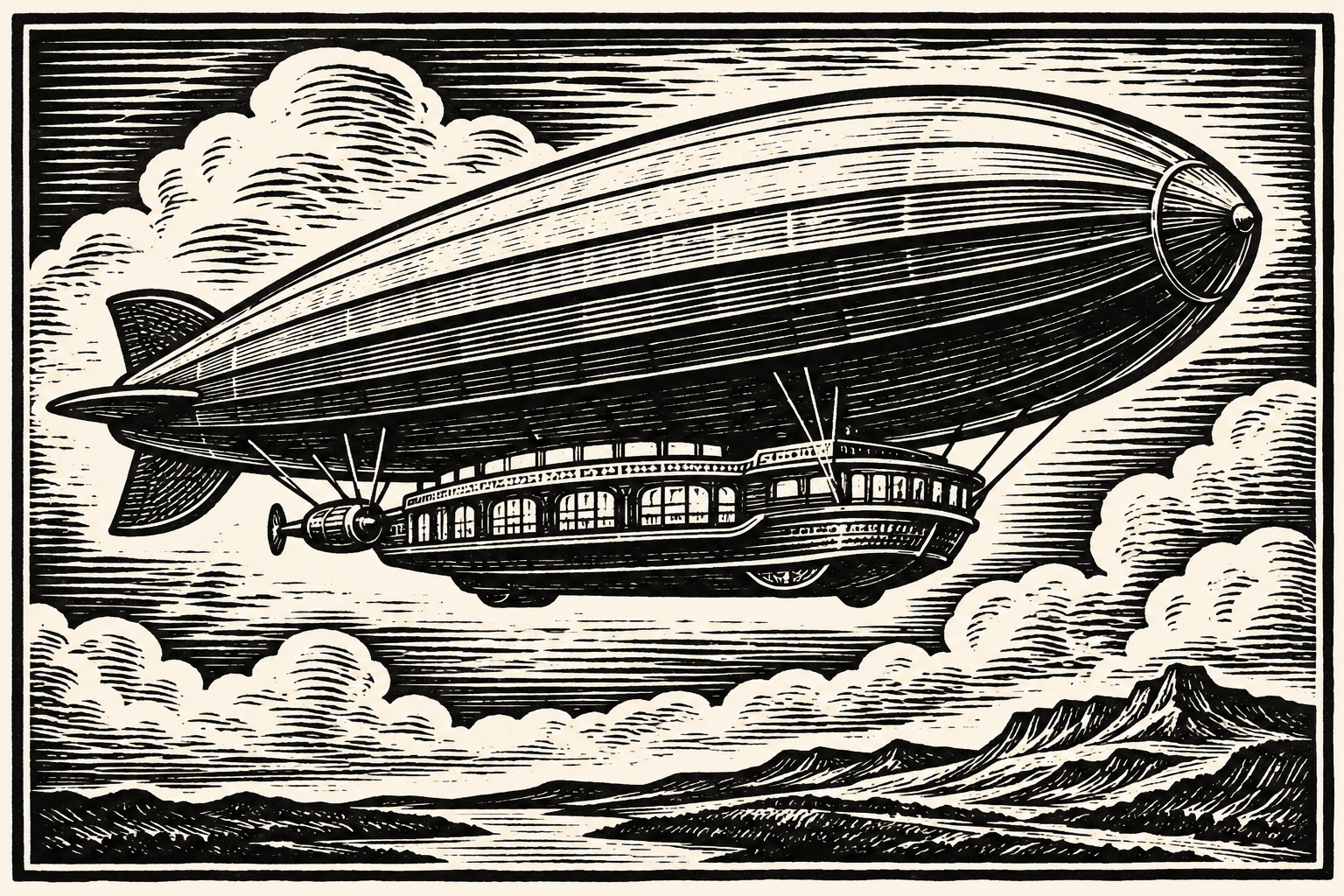
    1939 Zeppelin adventure

    Rhein-Main Airfield, Frankfurt, June 1939

    The steward held out a silver tray.

    “Matches, mein Herr. Lighters. Anything that makes a spark.”

    Jack Brandt emptied his coat pocket. One box of Swedish safety matches. Half full.

    He set it on the tray. The steward thanked him and moved on.

    Jack kept one match. It was tucked behind the sweatband of his hat. Old habits.

    Above him the Nordstern filled the evening sky. Eight hundred feet of silver skin. Swastikas on the tail fins. Searchlights crawled along her belly. She was the newest ship in the German fleet. She flew on hydrogen because America would not sell Germany helium.

    Hydrogen. Jack had read the newspapers in 1937. Everybody had.

    “Herr Brandt?”

    The voice was soft. Polite. Jack turned.

    The man wore a gray civilian suit that fit him like a uniform. Pale eyes. A small smile that never reached them.

    “Sturmbannführer Erich Voss,” the man said. “Security. We are responsible for the passengers’ safety on this crossing.”

    “Swell,” Jack said. “I feel safer already.”

    “You sell instruments. Gauges. Calipers. Yes?”

    “Precision instruments. Milwaukee’s finest.”

    “And you were at the docks on Tuesday, Herr Brandt? The night the Gestapo lost a prisoner by the river?”

    Jack smiled. “I was at the opera on Tuesday. Wagner. Four hours. I’d remember a dock.”

    “Would you?” Voss tipped his hat. “We will talk again. It is a long way to New York.”

    He walked off toward the gangway.

    Jack let out a breath. On Tuesday a man in a black mask had pulled a Jewish printer out of a Gestapo car by the Main River. The masked man left a snuffed match on the car’s hood. New York papers called him the Lamplighter.

    Jack had never seen the printer again. He hoped the man was in Holland by now.

    “You are nervous, young man. Everybody is nervous the first time.”

    An old man stood at his elbow. White mustache. A cardboard suitcase tied with string. He held a yellowed slip of paper in both hands like a holy relic.

    “Elias Brenner,” the old man said. “Bookkeeper. Retired. Friedrichshafen.”

    “Jack Brandt. Salesman. Not retired.”

    Brenner held up the paper. “Do you know what this is?”

    Jack squinted. It was a ticket. Printed in 1920. Luftschiff Nordstern. Friedrichshafen. Berlin. Stockholm.

    “There was another Nordstern?”

    “The first one. LZ 121. Built for the Stockholm route. I bought a ticket to go marry a Swedish girl. Ingrid.” Brenner sighed. “The ship never flew the route. In 1921 the French took her. Reparations. They renamed her Méditerranée. Scrapped in 1926.”

    “And Ingrid?”

    “The first Nordstern, young man, went to the French. Like my Ingrid’s letters, she simply stopped arriving.” He folded the ticket away. “Nineteen years I waited to fly on a Nordstern. Tonight I fly.”

    The ground crew shouted. Ropes slapped. Jack followed the old man up the gangway into the belly of the ship.


    The Chief Steward served dinner at nine.

    Consommé. Then fish. Then tenderloin on toast. The dining room ran down the whole port side of A deck. Silk paintings on the walls. White linen. Real silver.

    Jack ate and watched.

    There were thirty-one passengers. He counted. Salesmen do.

    At the far end of the lounge a woman played the piano. Lotte Krämer. Tall, dark, theatrical. She tickled the keys like they owed her money. The piano was aluminum. A Blüthner. It weighed less than a fat man and echoed like a church.

    A small man in a brown suit stood behind it. Paul Weller, piano tuner. He had a leather kit of hammers and mutes. Between Krämer’s pieces he leaned in and tightened a pin. He hummed while he worked. Mendelssohn. Jack recognized the tune. It was not a tune anybody hummed in Germany these days.

    Weller kept looking across the room. At Voss.

    Every time Voss looked back, Weller dropped his eyes.

    “Interesting man,” said the gentleman beside Jack.

    Dr. Anselm Roth. Gray beard. Chemist’s hands, stained yellow at the fingertips. He worked for IG Farben and carried a fat leather wallet he never let go of.

    “The tuner?” Jack asked.

    Roth leaned close. His voice dropped.

    “That man is not a tuner. He needs…”

    A shadow fell over the table.

    “Dr. Roth.” Voss smiled down at them. “We were hoping you would join us for a cigar. Before the smoking room closes?”

    Roth closed his mouth. He folded his napkin. He did not finish the sentence.

    “Of course, Herr Sturmbannführer.”

    Across the table, old Brenner tapped his water glass. The water sat slightly tilted.

    “You see that?” Brenner said to nobody. “She trims heavy forward. Right by the lounge. For forty years I kept books on freight. I know when something weighs more than the ledger says.”

    Nobody listened to him. Nobody ever listened to a bookkeeper.


    The smoking room was on B deck.

    It was the only place on the ship a man could light a cigarette. It was kept at higher pressure than the rest of the ship. If hydrogen ever leaked, it would be pushed out, not sucked in. You entered through a double door airlock beside a little bar. The barman watched everybody come and go.

    His name was Ernst Pohl. He was thin and gray and he counted things out loud.

    “One lighter,” he told Jack at eleven thirty. “Electric. Mounted on the wall. Nobody takes fire out of this room. Nobody.”

    “I believe you.”

    “I was at Lakehurst. May 1937. Ground crew.” Pohl wiped a glass. “Thirty six people. I counted them after.”

    Jack did not ask anything else.

    At midnight Pohl sealed the room. One passenger remained inside. Roth. He wanted one last cigar alone, he said, with the lights of the Rhine below the sealed windows.

    Pohl wrote it in his log. 24.00. Dr. Roth. Alone.

    Jack went to bed.


    At one in the morning somebody screamed.

    Jack was in the corridor in his shirtsleeves before the second scream. Passengers spilled out of fabric cabins. A steward ran past.

    The airlock stood open. Pohl stumbled out of it, both hands over his eyes.

    “My head,” he gasped. “I can’t see. Everything is dark. Everything… so small.”

    Jack caught him. Pohl’s pupils were pinpricks. Black dots in gray glass.

    Through the inner door Jack saw Roth.

    The chemist sat in a leather chair by the window. His cigar had fallen to the carpet, unlit. His eyes were open. His pupils were tiny. There was no blood. No wound. Just a faint smell in the air. Sweet. Like fruit left too long in a bowl.

    Jack started forward.

    A hand stopped him.

    “No, Herr Brandt.”

    Voss stepped past him into the room. He walked straight to the body. He bent over Roth and studied the dead man’s face. He breathed the air. He stood there a full minute.

    Nothing happened to him.

    Jack noticed that. He noticed Voss’s eyes, too, in the electric light. Wide. Black. Like a cat’s at night.

    He filed it away. He did not know yet what drawer it went in.

    The captain arrived in a dressing gown. Kapitän Albrecht Sander. Short, square, worried.

    “A heart attack,” the captain said. “Yes? An old man. A cigar.”

    “Perhaps,” Voss said. “But we will investigate, Kapitän. Quietly. Nobody must panic. Not on this ship. Not with this hydrogen over our heads.”

    “Of course.”

    “The room stays sealed. I take charge of the inquiry. On the authority of Berlin.”

    The captain nodded. He looked relieved to hand it over.

    Voss turned. His eyes found Jack.

    “Herr Brandt. You sat with Dr. Roth at dinner. He whispered to you. We saw it.”

    “He was telling me about the fish.”

    “Was he? Then you will tell us about the fish. At length.” Voss nodded to two stewards. “Herr Brandt is confined to his cabin. A guard at the door. Nobody visits him.”

    “You’re arresting me?”

    “We are protecting you,” Voss said. “Somebody aboard this ship has killed a man without leaving a mark. You were the last one he spoke to. If you are innocent, you are in danger. If you are not…”

    He shrugged.

    The stewards took Jack by the arms.

    He let them. Fighting on a hydrogen ship was a bad idea. He had a feeling it was going to come to that anyway.

    They walked him down the corridor past the dark windows. Somewhere below, the Atlantic waited.

    The door of his cabin closed. A key turned.

    Jack sat on his bunk in the dark.

    A man was dead from something nobody could see. The killer was still aboard. So was the weapon. And the only man who had tried to warn him was cooling in a sealed room above sixteen gas cells full of hydrogen.

    Jack Brandt was a prisoner.

    Somewhere on this ship was death. Only death wasn’t locked up.

    Part Two coming

    Read more: The Zepplin of Lost Souls (Part One)
  • Jake Rutledge and the Guy With Bad Timing: Jake Rutledge and the Guy with Bad Timing – Part Seven

    Jake Rutledge and the Guy With Bad Timing: Jake Rutledge and the Guy with Bad Timing – Part Seven

    “I am not sure he is my brother, and I am not sure he isn’t my brother,” I was talking to myself and Charlie didn’t care. With Dan missing, I felt absurd once I heard the words come out of my mouth. Charlie just let me ponder it out.

    “He resembles him, but he doesn’t act like him,” I pondered. “And you know Charlie, he knew nothing about the time I smacked him in the head with my front forks. I don’t think he’s my brother.”

    “Well, then who is he?” asked Charlie who bounced in his seat as we passed over a pothole.

    Before he was dead, I started asking Dan some questions. The motorcycle accident came up as a little test of his memory and my brother failed. He knew nothing about being hit in the head with my front forks. He failed a few other memory tests too. Such as the time we tried to set the farm ablaze with fireworks.

    None of this matter though because Dan didn’t want to walk down memory lane. He was still on a mission and before I could call him on his memory lapses, he told me about his plan to get back to the base, capture the weather machine, and keep the Air Force from turning it into a weapon.

    He had pulled himself off the IV stand and was still alive. He knew the Air Force would come for him, and he was just waiting.

    “I will power down for a few minutes and get some rest,” Dan told me before shutting his eyes. A few minutes later I found the contacts. Dan never moved an inch. Then the Air Force came, Dan escaped, and Charlie and I were going to the brig.

    I caught Charlie up to the present.

    Dan had told me he had to get back to the base, sneak into the lab, and take away the weather machine. I presumed he meant to destroy it, but everything was happening so fast I forgot to ask questions.

    “The guy isn’t dead?” Charlie questioned my story. We were riding with five of the airmen, and they had already warned us to “shut our mouths.”

    “No. In fact, he should be right behind us.”

    I lost track of Dan when I had to run outside to stop World War III. Before I left the diner, I convinced Sally to attend to him and do whatever he wanted.

     I now wondered if that was such a good idea. Sally counted on tips to round out her check, and she might have put off any field trips to the base. I glanced at my watch.

    “Just after two,” I muttered to myself. “Sally should have finished the lunch rush.”

    “What part of quite don’t your get?” an airman asked. “Why are you talking to yourself?”

    I glared at him, but didn’t open my mouth again until we rolled into the base. Charlie looked at me and nodded.

    We have been friends a long time and Charlie seems to understand my impromptu plans by a simple glance. He rose from his seat and lunged at me.

    “You no-good bastard,” Charlie screamed. “This is your fault.” He threw a punch, which landed on my chin. I fell backward. As I scrambled to climb up, two airmen wrestled Charlie and pinned him against a tire.

    “What the hell is going on in here?” Colonel Cox stood at the back of the van waiting for an answer.

    “These two haven’t followed a single command since we left Pretty Prairie, sir,” said an airman. “And now this one wants to fight.” He grabbed Charlie by the shoulder and stood him up.

    “Put them in the brig until we can sort them out,” said Colonel Cox.

    Three airmen shoved me and Charlie into what amounted to a chain-link cage. We each had a bed and a blanket. Where the bathroom was, I didn’t know, but I wished I had asked.

    They searched my pockets and took away the contacts in the medicine bottle. I hoped they would think it was only aspirin. We were now alone.

    “The weatherman is alive?” said Charlie.

    “I think he has a few more lives left to live,” I said as I looked around the cages for a way out.

    “Nice punch. I was hoping they would take us right to the brig.”

    “Anything else I can do?”

    “You can look for a way out of here.” Charlie looked around his cell and the warehouse they locked us in. I couldn’t find a door.

    “I’m guessing that guy isn’t your brother?”

    “Pretty sure. He favors him though.” I had decided there was no way the weatherman was Dan.

    “You keep saying that like you hope it’s true.” I thought Charlie made a point. Losing Dan with no trace in Afghanistan had left me and my mom and dad lost. It was too much to hope for a happy reunion.

    Still, the weatherman lacked some of Dan’s features, and he had no memory of some of our key exploits as kids. Memory loss? I think I was putting too much faith in hope.

    “We need to figure out how to escape.” I looked around the room and tried to push way the fence or twist around the posts. It was sturdy. Someone stretched the fence trying to kick through it. I pulled at the chain link and tried to stretch it more to free it from the post.

    “We don’t have a lot of time,” I said. “Charlie, find a camera and see if we’re being watched.”

    I turned over my bed to see if I could tear off a leg and use it to rip the fence. The aluminum leg bent off after a little effort. I used it as a lever to pull away the fence from the post.

     I made progress and soon one of the fence wires broke. I tore into it with more fury and snapped a few more wires. Now, I could grab the fence and pull it away from the post.

     A small hole formed against the wall. I pulled on the post trying to bend it in half. Soon, I could push my head through the hole. Two wiggles and I was outside the cell.

    “You made swift work of that,” said Charlie. “Now get me out.”

    I used the bed leg to work on breaking the lock holding Charlie in. It was a tough go, and the lock refused to break. Out of the corner of my eye I followed an arm reach around me and drag me to the ground. An airman had me pinned. I observed a hidden camera behind our cell.

    “Well Charlie, you missed a camera,” I said pushing back at the airman. I saw a second airman throw Charlie back into the cell. He bounced back from the fence, and judging from the look on his face, he knew he had messed up.

    The airman slammed me into the cell. He wrenched my arm around my back, as a steady stream of blue-uniformed sentries filled the space between me and Charlie.

    They rushed in and brought Charlie out holding his hands up. They had us and there was nothing I could do to stop them.

    I pulled away, and the guard held me as another brought down a baton in a swift thrust to my shoulders.

    I let out a groan and everything went black.

    I woke up in a huge computer room with various people twisting knobs, staring at screens, and recording measurements on tablets. The guards had taken off my cuffs, and I rubbed my sore neck. In the center of the room, nurses were intent on taking care of Dan, the weatherman.

    They cleaned his face and from his neck down he wore a white jumpsuit. The clothing appeared too white, and I thought they wrapped him in a cloud. I recalled the storm, the torn up clinic, and Dan going off to the Middle East.

    “I thought you were dead,” I said to Dan who acted like he did not hear me. I would have asked him again if Colonel Cox hadn’t boomed from behind me.

    “Oh, he’s very much alive.” The colonel walked around to block my view of the weatherman. “Only he’s not your brother.”

    I sort of knew this already although I still hoped it was Dan.

    “Well, you had me fooled.”

    “You know,” said the colonel. “We never even considered the two of you might run into each other.”

    “It is a mystery,” I said. “I suppose you’ve cloned my sister too?”

    “I wouldn’t call it cloning.” I scanned the room as the various scientists turned toward me.

    “More like artificial intelligence.”

    Part One – Jake Rutledge and the Guy with Bad Timing
    Part Two – Jake Rutledge and the Guy with Bad Timing
    Part Three – Jake Rutledge and the Guy with Bad Timing
    Part Four – Jake Rutledge and the Guy with Bad Timing
    Part Five – Jake Rutledge and the Guy with Bad Timing
    Part Six – Jake Rutledge and the Guy with Bad Timing
    Part Seven – Jake Rutledge and the Guy with Bad Timing
    Part Eight – Jake Rutledge and the Guy with Bad Timing
    Part Nine – Jake Rutledge and the Guy with Bad Timing

    Looking for a new adventure? Walk around in Jake’s shoes.https://t.co/OOkd9VBHyh pic.twitter.com/FvqK46Ra8w

    — wordsmithholler (@wordsmithholler) July 11, 2018


    Read more: Jake Rutledge and the Guy With Bad Timing: Jake Rutledge and the Guy with Bad Timing – Part Seven
  • Jake Rutledge and the Guy With Bad Timing: Jake Rutledge and the Guy with Bad Timing – Part Six

    Jake Rutledge and the Guy With Bad Timing: Jake Rutledge and the Guy with Bad Timing – Part Six

    The airmen formed up like an F-16 to storm the diner. I kept tabs on them from the street as they poked, prodded, and shoved the farmers. Shortly, the biggest airmen came out.

    “He’s not here.” I figured he missed the storm cellar. “Try the basement,” I said.

    Colonel Cox pointed at the diner and the soldier ran back inside. I saw Sally point to the floor and a line of blue airmen disappeared into the basement.

    After ten minutes, the big guy came out again.

    “He’s not in there.”

    “What are you pulling?” Colonel Cox said. He didn’t give me the impression it thrilled him.

    “He was lying down there earlier,” I poked around the room. “He couldn’t have gone too far.”

    “Why don’t you show us.” The Colonel pushed me from behind toward the diner.

    I led him and the rest of the Air Force’s finest down the stairs into the basement. The farmers watched us pass, and each one was whispering. I’m sure this was the most excitement any of them had in a long time.

    The basement was full of shadows and it took a while for my eyes to adjust. I thought about the contacts in my pocket and made sure they were still there. Through the dancing light, I could recognize Dan’s outline where I had left him.

    “He’s right there.” I’ll admit I had a snarky tone in my voice. I was thinking how stupid were these people?

    “You mean this pile of clothes,” an airman said. He surprised me.

    I rushed over to where Dan had been bleeding an hour ago and where I found him lying on the table. There was nothing but his clothes.

    “Someone had to take him!”

    It made little sense. He was lying right there and now there was nothing.

    “Detain this asshole and make sure he doesn’t disappear,” Colonel Cox said. “Funny guy. Maybe a trip to base can help clear your memory. Or, you can sit in the brig and think about it.”

    The giant airman grabbed me from behind and pinned my arms. I tried to run. Too bad he was stronger and faster. We climbed out of the basement with me in handcuffs.

    “Jake, what’s going on?”

    “Just a quick field trip to see what kind of steak they serve in the Air Force,” I said. “How do you like yours? I’ll bring one back.”

    “Don’t count on it, miss,” Colonel Cox said. “He’s likely to be locked up for a while.”

    They shoved me into the van and I found Charlie waiting in the corner for me.

    “They got you too?”

    “Yep,” Charlie said. “Those airmen don’t like a pitchfork in the ass.”

    “Dan’s gone,” I said. “Apparently, he wasn’t as dead as I thought.”

    The truck lurched forward, and we moved toward the air base.

    “We’ll it looks like we’re on our way,” I said. “We should be able to find figure all this out in no time.”

    Part One – Jake Rutledge and the Guy with Bad Timing
    Part Two – Jake Rutledge and the Guy with Bad Timing
    Part Three – Jake Rutledge and the Guy with Bad Timing
    Part Four – Jake Rutledge and the Guy with Bad Timing
    Part Five – Jake Rutledge and the Guy with Bad Timing
    Part Six – Jake Rutledge and the Guy with Bad Timing
    Part Seven – Jake Rutledge and the Guy with Bad Timing
    Part Eight – Jake Rutledge and the Guy with Bad Timing
    Part Nine – Jake Rutledge and the Guy with Bad Timing

    Read more: Jake Rutledge and the Guy With Bad Timing: Jake Rutledge and the Guy with Bad Timing – Part Six
  • A Tall Tale of Sin: Greyhound Arriving

    I work downtown Las Vegas. For all of the glitz and wild scenes on Fremont Street, what is often overlooked is this town is a business. And that means for every cup tossed on the ground someone has to come along and pick it up. While the entire street is a stage, it still needs to rest, if only for a few hours between parties.

    I’m also fascinated with neon and what it means. Las Vegas discards its neon signs; they can be found at the Neon Museum. Unfortunately, many of these signs no longer light up. I often wonder if each neon sign is waiting for someone to jump start their hearts so their lights can be alive again.

    I’ve been pondering an idea for a while that will take more effort than a 1,000 word short story. Not quite a novel; I think it’s more of a 60-page novella. However, it will take some time to write and I may need to draft it in smaller assignments.

    Clearly this story will have some fantasy, crime, and drama.

    So what will follow is a serialized short story and a way for me to plod along until I finish it. Short of NaNoWriMo, I tend to drop the ball and there are lots of stories I have written waiting for a finish. My two NaNoWriMo efforts still need me to edit them; those stories may never see the light of day! Too many half-baked ideas waiting for an editor. With this project, I anticipate it will be a forced march of sorts to reach the finish line. Hopefully, it doesn’t end up in a trash can.

    Each segment will be like a short chapter with the main title “A Tall Tale of Sin” preceding the current effort.

    I plan to discuss my story idea and share my planning. Frequently, I may update this post to add character sketches or to expand on the idea. By the way, you can find the tools I have created to help me write here.

    Planning

    Read more: A Tall Tale of Sin: Greyhound Arriving