The two suns climbed the west sky. One was an old red sun, fat and slow. The other was a small white point, sharp as a needle. It had not been there when Xabier first came to the Slydal Plain. He had stopped wondering about it. A planet this far out could keep whatever stars it liked.
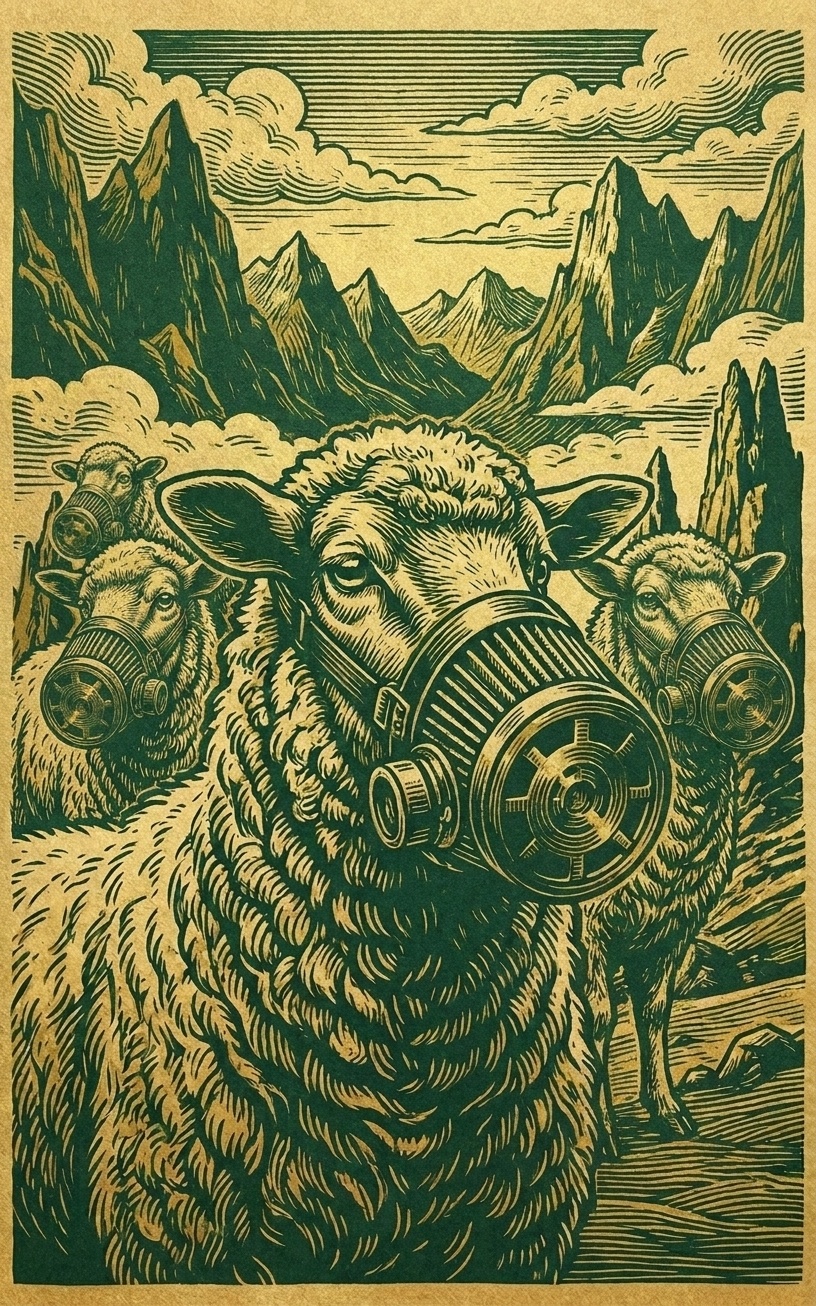
Below him, the five sheep grazed in the triangle corner of the field. The two rams pulled at the grass. The doe-eyed ewe stayed close to her lamb. The old ewe stood a little apart, chewing slowly, her weight belt sagging on her thin haunches. Xabier lay flat behind the rock with the controller in his lap. The buried wire ran under his elbow like a vein.
He waited. Nymphs bounced in his hair. The locusts hummed. A sheep bleated far up the field, and the flock answered.
Nothing moved in the corner.
“Etorri,” he whispered. “Come on, then.”
He set his thumb on the knob and turned it a hair. A needle on the dial twitched. He turned it again. The posts in the corner gave off a faint tick, tick, like rain on the freighter’s hull. He swept the dial slowly from one end to the other. Nothing. He swept it back.
Halfway up the dial, the air in the corner shivered.
It looked like heat over a road. Then it looked like a man. Four outlines stood among the bait sheep, silver grey, edged in thin light. A fifth stood farther back near the cliff, as if he had come to watch. They wore hoods and long cloaks that hung oddly in the heavy, still air. Filters covered their mouths, just like his own. Each held a long gun with a fat drum under the barrel, and a fine cable wound on the drum.
They were men. Not monsters. Men.
Xabier’s mouth went dry. He had pictured bows and arrows. He had pictured something with claws. He had not pictured men who breathed through filters and stood on two legs in his field.
One of the outlines looked down at his own arm. He had seen himself go silver. He jerked his head around at the others. The array had worked. They knew it.
The four hunters scattered like quail. But one of them was quicker with his fear than the rest. He swung his gun and fired. A blue flash snapped from the barrel, a spark where the cable left the cloak. The harpoon took the bigger ram in the neck from no more than ten meters off. The ram fell bleating. The drum whined, and the cable went tight, and the ram began to slide across the grass toward the rocks.
“Ez!” Xabier was on his feet before he thought about it.
He grabbed his staff and the shears from his belt. He pushed off the rock and flew. One stroke of the staff against the ground, then another, rowing through the dense air in long, low arcs. He came down beside the sliding ram and caught the cable in the blades of his shears. It was thin as fishing line and tough as wire. He squeezed with both hands. The cable parted with a crack and whipped back into the ripple.
The ram lay still. Blood ran into the wool at his neck. Xabier knew that wound. He had seen it on three sheep already.
The hunters ran for the cliffs. Their outlines flickered as they crossed the array wire, silver, then nothing, then silver again. The slowest of them was the one at the back, the watcher. He moved like a man with stiff knees. His cable trailed behind him, loose, unreeled, dragging through the bracken.
Xabier dug in his staff and pushed. He flew. He landed with both boots on the trailing cable, and the old hunter jerked to a stop like a dog at the end of a lead.
They both went down. In this gravity, going down took a long time. They tumbled together in a slow, ugly arc, cable wrapping their legs, the gun spinning away. The hunter’s elbow caught Xabier in the ribs. Xabier grabbed a fistful of zamarra. It was curly, tough leather, and he clung to the wool. It tore at the hood, and the hunter twisted away.
They landed in the grass. Xabier toppled over. He held the torn hood in one hand and raised his staff with the other.
He did not swing.
He was looking at his own face.
It was older. Forty years older, maybe more. The sandy brown hair had gone grey and thin. Deep lines ran from the nose to the corners of the mouth. But it was his nose. His chin. His small ears that his mother used to tug. The eyes were his eyes, set in a face the sun had worked over for a long time.
The old man looked up at him. His filter hissed. Something passed over his face that Xabier could not read. It looked like grief.
“Txiki,” the old man said.
Little one.
Then he twisted like an eel, kicked free of the cable, and was up and gone in three long bounds. His cloak flickered silver over the array wire and vanished into the rocks. He left the gun in the grass.
Xabier sat in the bracken for a long time. His ribs hurt. His hands shook. The flock watched him from up the field.
He picked up the gun. It was heavier than it looked. The drum held a long coil of the fine cable, and the harpoon was a short barbed shaft with a ring at the tail. He wrapped his hand around the grip.
It did not fit. The grip had been worn smooth by years of a hand, and the hand had been on the wrong side. The thumb groove sat on the right. The finger grooves curved for a left hand. Xabier was right handed. He had always been right-handed. His mother had slapped his left hand off the spoon until it was.
He set the gun down.
“That’s not my hand,” he told the ram. “That’s a left hand. Mother would have slapped it.”
He thought of the face he had glimpsed in the ripple that first day, when the black sheep fell. He had told himself it was a trick of the light. It had looked familiar even then. He had not let himself wonder why.
He sat with the dead ram until the chimes rang. Tin, ting, tin, tang. The flock came down off the hill on its own, the way it always did when the bells played. He walked the four remaining sheep back to the barn. The old ewe walked the slowest. He dragged the ram himself, rowing with his staff, and laid him in the shade by the door.
Inside, he fitted the sheep with fresh filters. He did not wish them a good day. He went to the tack drawer.
The note was where it had always been, under the spare straps. He had found it his first day, folded in four. He had always thought the shepherd before him had left it. A kind man, he had decided. A careful man. He unfolded it now.
Kontuz ehiztariekin. The hunters will come for the five.
He had read it a hundred times and thought it was nonsense.
“The five what?” he had asked the sheep that first day. Maite had only chewed.
He knew now.
He took the note to the workbench and laid it next to his map of the field. He had drawn the map two days ago. Squares at each post. Thin lines for the wire. Labels in his own careful hand. Hegoaldeko zutoina. Zelaia. Zuhaitz.
He looked at the note. He looked at the map.
The “K” had the same lazy loop. The “h” leaned the same way. And there, in ehiztariekin, the “z” had a crooked tail that dropped below the line and hooked back. He had made that “Z” since he was six years old. His teacher had called it a little fishhook. No one else on Earth made a “Z” like that.
He looked at Zelaia on his map. The same fishhook.
The warning was in his own handwriting.
“Nirea da,” he said to the empty barn. “The note’s mine. I wrote it, and I don’t remember writing it.”
As war looms over the continent, a new hydrogen zeppelin, the Nordstern, slips her moorings in Frankfurt bound for New York. An original short story written in the style of 1930’s Pulp Fiction, this tale is a thrilling 1939 zeppelin adventure.
Rhein-Main Airfield, Frankfurt, June 1939
The steward held out a silver tray.
“Matches, mein Herr. Lighters. Anything that makes a spark.”
Jack Brandt emptied his coat pocket. One box of Swedish safety matches. Half full.
He set it on the tray. The steward thanked him and moved on.
Jack kept one match. It was tucked behind the sweatband of his hat. Old habits.
Above him the Nordstern filled the evening sky. Eight hundred feet of silver skin. Swastikas on the tail fins. Searchlights crawled along her belly. She was the newest ship in the German fleet. She flew on hydrogen because America would not sell Germany helium.
Hydrogen. Jack had read the newspapers in 1937. Everybody had.
“Herr Brandt?”
The voice was soft. Polite. Jack turned.
The man wore a gray civilian suit that fit him like a uniform. Pale eyes. A small smile that never reached them.
“Sturmbannführer Erich Voss,” the man said. “Security. We are responsible for the passengers’ safety on this crossing.”
“Swell,” Jack said. “I feel safer already.”
“You sell instruments. Gauges. Calipers. Yes?”
“Precision instruments. Milwaukee’s finest.”
“And you were at the docks on Tuesday, Herr Brandt? The night the Gestapo lost a prisoner by the river?”
Jack smiled. “I was at the opera on Tuesday. Wagner. Four hours. I’d remember a dock.”
“Would you?” Voss tipped his hat. “We will talk again. It is a long way to New York.”
He walked off toward the gangway.
Jack let out a breath. On Tuesday a man in a black mask had pulled a Jewish printer out of a Gestapo car by the Main River. The masked man left a snuffed match on the car’s hood. New York papers called him the Lamplighter.
Jack had never seen the printer again. He hoped the man was in Holland by now.
“You are nervous, young man. Everybody is nervous the first time.”
An old man stood at his elbow. White mustache. A cardboard suitcase tied with string. He held a yellowed slip of paper in both hands like a holy relic.
“Elias Brenner,” the old man said. “Bookkeeper. Retired. Friedrichshafen.”
“Jack Brandt. Salesman. Not retired.”
Brenner held up the paper. “Do you know what this is?”
Jack squinted. It was a ticket. Printed in 1920. Luftschiff Nordstern. Friedrichshafen. Berlin. Stockholm.
“There was another Nordstern?”
“The first one. LZ 121. Built for the Stockholm route. I bought a ticket to go marry a Swedish girl. Ingrid.” Brenner sighed. “The ship never flew the route. In 1921 the French took her. Reparations. They renamed her Méditerranée. Scrapped in 1926.”
“And Ingrid?”
“The first Nordstern, young man, went to the French. Like my Ingrid’s letters, she simply stopped arriving.” He folded the ticket away. “Nineteen years I waited to fly on a Nordstern. Tonight I fly.”
The ground crew shouted. Ropes slapped. Jack followed the old man up the gangway into the belly of the ship.
The Chief Steward served dinner at nine.
Consommé. Then fish. Then tenderloin on toast. The dining room ran down the whole port side of A deck. Silk paintings on the walls. White linen. Real silver.
Jack ate and watched.
There were thirty-one passengers. He counted. Salesmen do.
At the far end of the lounge a woman played the piano. Lotte Krämer. Tall, dark, theatrical. She tickled the keys like they owed her money. The piano was aluminum. A Blüthner. It weighed less than a fat man and echoed like a church.
A small man in a brown suit stood behind it. Paul Weller, piano tuner. He had a leather kit of hammers and mutes. Between Krämer’s pieces he leaned in and tightened a pin. He hummed while he worked. Mendelssohn. Jack recognized the tune. It was not a tune anybody hummed in Germany these days.
Weller kept looking across the room. At Voss.
Every time Voss looked back, Weller dropped his eyes.
“Interesting man,” said the gentleman beside Jack.
Dr. Anselm Roth. Gray beard. Chemist’s hands, stained yellow at the fingertips. He worked for IG Farben and carried a fat leather wallet he never let go of.
“The tuner?” Jack asked.
Roth leaned close. His voice dropped.
“That man is not a tuner. He needs…”
A shadow fell over the table.
“Dr. Roth.” Voss smiled down at them. “We were hoping you would join us for a cigar. Before the smoking room closes?”
Roth closed his mouth. He folded his napkin. He did not finish the sentence.
“Of course, Herr Sturmbannführer.”
Across the table, old Brenner tapped his water glass. The water sat slightly tilted.
“You see that?” Brenner said to nobody. “She trims heavy forward. Right by the lounge. For forty years I kept books on freight. I know when something weighs more than the ledger says.”
Nobody listened to him. Nobody ever listened to a bookkeeper.
The smoking room was on B deck.
It was the only place on the ship a man could light a cigarette. It was kept at higher pressure than the rest of the ship. If hydrogen ever leaked, it would be pushed out, not sucked in. You entered through a double door airlock beside a little bar. The barman watched everybody come and go.
His name was Ernst Pohl. He was thin and gray and he counted things out loud.
“One lighter,” he told Jack at eleven thirty. “Electric. Mounted on the wall. Nobody takes fire out of this room. Nobody.”
“I believe you.”
“I was at Lakehurst. May 1937. Ground crew.” Pohl wiped a glass. “Thirty six people. I counted them after.”
Jack did not ask anything else.
At midnight Pohl sealed the room. One passenger remained inside. Roth. He wanted one last cigar alone, he said, with the lights of the Rhine below the sealed windows.
Pohl wrote it in his log. 24.00. Dr. Roth. Alone.
Jack went to bed.
At one in the morning somebody screamed.
Jack was in the corridor in his shirtsleeves before the second scream. Passengers spilled out of fabric cabins. A steward ran past.
The airlock stood open. Pohl stumbled out of it, both hands over his eyes.
“My head,” he gasped. “I can’t see. Everything is dark. Everything… so small.”
Jack caught him. Pohl’s pupils were pinpricks. Black dots in gray glass.
Through the inner door Jack saw Roth.
The chemist sat in a leather chair by the window. His cigar had fallen to the carpet, unlit. His eyes were open. His pupils were tiny. There was no blood. No wound. Just a faint smell in the air. Sweet. Like fruit left too long in a bowl.
Jack started forward.
A hand stopped him.
“No, Herr Brandt.”
Voss stepped past him into the room. He walked straight to the body. He bent over Roth and studied the dead man’s face. He breathed the air. He stood there a full minute.
Nothing happened to him.
Jack noticed that. He noticed Voss’s eyes, too, in the electric light. Wide. Black. Like a cat’s at night.
He filed it away. He did not know yet what drawer it went in.
The captain arrived in a dressing gown. Kapitän Albrecht Sander. Short, square, worried.
“A heart attack,” the captain said. “Yes? An old man. A cigar.”
“Perhaps,” Voss said. “But we will investigate, Kapitän. Quietly. Nobody must panic. Not on this ship. Not with this hydrogen over our heads.”
“Of course.”
“The room stays sealed. I take charge of the inquiry. On the authority of Berlin.”
The captain nodded. He looked relieved to hand it over.
Voss turned. His eyes found Jack.
“Herr Brandt. You sat with Dr. Roth at dinner. He whispered to you. We saw it.”
“He was telling me about the fish.”
“Was he? Then you will tell us about the fish. At length.” Voss nodded to two stewards. “Herr Brandt is confined to his cabin. A guard at the door. Nobody visits him.”
“You’re arresting me?”
“We are protecting you,” Voss said. “Somebody aboard this ship has killed a man without leaving a mark. You were the last one he spoke to. If you are innocent, you are in danger. If you are not…”
He shrugged.
The stewards took Jack by the arms.
He let them. Fighting on a hydrogen ship was a bad idea. He had a feeling it was going to come to that anyway.
They walked him down the corridor past the dark windows. Somewhere below, the Atlantic waited.
The door of his cabin closed. A key turned.
Jack sat on his bunk in the dark.
A man was dead from something nobody could see. The killer was still aboard. So was the weapon. And the only man who had tried to warn him was cooling in a sealed room above sixteen gas cells full of hydrogen.
Jack Brandt was a prisoner.
Somewhere on this ship was death. Only death wasn’t locked up.
(Torely Stone continues to investigate the death of Tom Dantry by interviewing suspects Jenna Shaw and Rachel Holt. He also comes face-to-face with the killer and pays the price as he dances with the devil in the third part of the novella The Spill of Sangria Blood.)
The Kokosia Zoo was a sensory overload on this balmy Saturday afternoon. A discord of shrieks—both human and animal—assaulted my ears as I shuffled away from Spinnakers in the middle of the zoo. My nostrils were assaulted by the pungent cocktail of sunscreen, cotton candy, and eau de elephant dung.
Everywhere I looked a veritable menagerie of humanity that rivaled the actual zoo inhabitants. Frazzled moms pushed strollers like battering rams, their exhausted expressions a stark contrast to their spawn’s sugar-fueled mania. I narrowly dodged a sticky-fingered toddler on a rampage, his harried mother in hot pursuit.
“Trevor, no! We do not lick the penguin enclosure!”
I snorted, earning a dirty look from Trevor’s mom. Sorry, lady. Your kid’s probably building immunity or something.
As I meandered past the flamingo pond, I saw a gaggle of single men prowling the pathways. They strutted about like peacocks, eyes darting from animal exhibits to any female that looked vaguely unattached. One bold specimen sidled up to a young woman peering at the warthogs.
“Hey there. You really like those little guys. Wanna grab a coffee and talk about… warthogs?”
I cringed at the awkward pickup attempt. The woman’s polite but firm rejection was almost drowned out by a nearby lion’s well-timed roar.
Oh to be young and stupid again, I thought to myself. After all my experiences, I still was trying to prove something. I emphasized with the guy and thought about my own bad timings. A lot of failures, with the end of my sheriff career at the top of them. Why is it that no matter all the good you do, you’re only remembered for the failures?
Dantry’s death had me back in the thick of things. Maybe solving this would land me into real police work? So far, I had no clue about the killer, but “Project Atlas” was pointing me to a motive. What was Dantry hiding and who was involved?
Jenna was a possibility and so was Rachel Holt. But just because they were women, didn’t mean they weren’t involved. I needed to go over that list in the “Project Atlas” folder. As soon as Winters’ searched Dantry’s office and put it into evidence.
The lush vegetation lining the walkways provided a brief respite from the my thoughts about the case. I paused beneath a towering eucalyptus, its distinctive aroma mingling with the salty tang of the nearby Pacific. A gentle breeze carried the scent of blooming jasmine, a stark contrast to the earthy musk emanating from the primate enclosures.
As I continued my walk through the zoo, with its mix of humanity and nature, I couldn’t help thinking that the peacefulness was a far cry from the events of last night. And I wondered if things had settled down or if more monkey business was on the way.
Winters and crime scene techs were going through Dantry’s office when I showed up to make sure he’d secured the “Project Atlas” folder. He waived for me to join him. Jenna Shaw also was in the room rocking in place and holding a brown day planner.
“Jenna has something that ties you to Dantry,” Winters reached for the planner. He pointed to an entry. “Looks like you and Dantry were going to meet regarding Project Atlas.”
I read the entry for myself: “Meet Stone. Discuss Atlas termination.”
“I have no idea,” I handed back the planner to Winters. “Maybe he planned to bring me into the loop.”
“Jenna thinks you met with Dantry and didn’t like what he told you. Gives you a motive,” Winters intimated and Jenna agreed by nodding.
“First off, me and Dantry would have to meet, which didn’t happen. And secondly, I was drinking mojitos when he was killed.”
After being shot at and chasing the killer, I was in no mood for Winters’ acting like a jackass. “Let’s go down this safari trail; a better question to ask is where were you Ms. Shaw?”
Jenna Shaw turned white. “I was home… I went to bed… I had nothing to do with the murder!”
“You told me Dantry and you were in a relationship.” I threw that little tidbit out to turn the table. Shaw turned fuming mad and beet red.
“I told you that in confidence,” she shrieked. “You had no right!”
“I suppose you can provide an alibi for the time of Dantry’s death?” Winters scrutinized Jenna’s face waiting for an answer.
“Just what I told you: I was home.”
“My assistant Carrie can back me up on my schedule and whether I met with Dantry or not.” I offered. ”Which sounds a whole lot more than what you’ve got Ms. Shaw.”
“Dantry came over… and we had a fight. But I didn’t kill him!” Shaw insisted.
“Sounds like you had motive Ms Shaw.” I caught Winters’ eye and he nodded.
Jenna Shaw glared at me with the penetrating eyes of a cobra. Winters handcuffed her arms behind her back and led her out of the office. At last we had someone who might have the means for Dantry’s death. If we had motive, was another story. We had to find out the answers when Winters questioned Ms. Shaw.
After I left Dantry’s office, I wandered down to see Rachel Holt. The head veterinarian was readying to leave her office.
“Mind if we talk?”
Dr. Holt’s fingers were fidgeting with the stethoscope around her neck, her eyes darting around the room like a caged animal looking for escape.
“Dr. Holt,” I said, my voice cutting through the tension. “You and Dantry had some disagreements recently, didn’t you?”
Rachel’s head snapped up, her eyes meeting mine. “I… we had professional differences, yes.”
“Professional differences?” I echoed, raising an eyebrow. “Would these ‘differences’ have anything to do with an expansion of the zoo?”
The color drained from Rachel’s face faster than water from a leaky bucket. “How did you-“
“I’m head of security, doc. It’s my job to know things.” I leaned in, lowering my voice. “Now, why don’t you tell me what’s really going on?”
Rachel’s shoulders slumped. “Dantry… his expansion plan focused on breeding endangered species without regard for genetic diversity. It was all about profit, not conservation. I couldn’t stand for it.”
“Project Atlas was just a plan, right?” I offered to Dr. Holt. She was puzzled.
“Is that what he was calling it? I never heard the name. He only told me about his plan a few weeks ago.”
Either she knew more than she was saying about “Project Atlas” or she was clueless. I nodded, filing away the information. Dr. Holt might be hiding something, but her passion was genuine.
Dr. Holt’s assistant rushed into the office. “We need you. A giraffe is hurt.” Without saying goodbye, Dr. Holt left faster than a gazelle.
No matter. Winters returned and I caught up on the attack at the Chimpanzee House. Three people stood out; Eli, Miguel, and the fast fellow who led me on a chase all over the zoo before vanishing.
“Miguel’s going to live and Eli needed some stitches,” Winters said.
“Why were they hanging out with the chimps?”
“Turns out they were doing some sleuthing on their own,” Winters explained. “They recognized arguing and thought it might be the murderer.”
“And the dart guns?”
“Eli says he grabbed one in the veterinary office behind the chimps for protection,” Winters stated. “Sounds like they needed it.”
I pondered what Winters told me.
“We aren’t any closer to solving this.”
“Well, maybe Ms. Shaw can fill in some cracks.”
Jenna Shaw sat alone in the interrogation room as Winters wandered in with the “Project Atlas” folder and a cup of coffee. He offered the cup to her as I watched them through the observation window.
“Do you want an attorney?” he asked.
“No. Nothing I say will connect me to Dantry’s murder.”
Winters started with some basic questions that led to Shaw’s fight with Dantry.
“What was the fight about?” Winters quizzed Shaw who tapped her fingers on the metal table. She offered nothing.
“Let’s talk about Project Atlas, shall we?”
A sharp intake of breath.
“I don’t recognize what you’re talking about,” she replied, her voice wavering.
Winters chuckled darkly. “Cut the crap, sweetheart. You and Dantry were more than just colleagues, weren’t you? What got you so mad you killed him for it?”
“I didn’t kill him. Although I wanted to.” Shaw shouted. “He was never going to leave his wife… so I ended it.”
That didn’t make sense. Dantry was a bachelor. I was sure of it.
“You sound like a woman scorned,” Winters scoffed. “I suppose you’re going to tell me now you just amicably ended it?”
“Yes. And then he left.” Shaw replied. “We were supposed to go to the ballet. I still had the tickets, so I went alone.”
This was new information and took the wind out of my sails.
“You can prove you went to the ballet?” demanded Winters.
“I met up with Dr. Finkle and his wife Mary. We stayed for the performance and then had drinks. I didn’t get home until after 1.”
Winters left the interrogation room and I met him in the hallway.
“If the Finkle’s confirm she was with them, she has an alibi.” Winters declared. “With an alibi we’re back to square one.”
“Listen, Dantry was a bachelor,” I pressed. “So, I can’t figure out this mysterious wife.”
Winters shrugged and went into the interrogation room to release her.
As I stood alone in the hallway, all I could think about was we were at the beginning. All we had was a folder covered in lipstick and perfume, and two female suspects who looked like they didn’t do it.
Shaw had said she and Dantry were having an affair and he wasn’t going to leave his wife. My friend Dantry was a bachelor, so Shaw related another thing that didn’t make any sense. The only thing that did make sense was Dantry was dead and we were no closer to pinning the killer.
The sheriff’s office was nothing like I remembered; it was cleaner and modern. The waiting area resembled a hotel lobby. The walls, once adorned with the weathered faces of sheriffs past, now gleamed with sterile white paint. A single photo hung in solitary splendor – an official-looking photo of Sheriff Shelton. All the deputies behind the counter were new and no one recognized me. So much for legacy; no one would pat me on the back if they wanted to.
I absently pushed through the glass doors into the bright afternoon sun. The courthouse square spread out before me, a patchwork of old and new. The sandwich shop where I’d spent countless lunch breaks still stood, but now it was flanked by a trendy coffee bar and a vegan bakery. Next to them was the park where I often ate my sandwich.
Uneven brick paver stones made up the streets around the courthouse square and they were just as worn. I took it all in; lawyers, defendants, and family walked around me conducting business with the county. I couldn’t help but think; they all were animals out on furlough waiting to be put back in their cages.
“Speaking of cages,” I laughed to myself. “I’d better get back to mine.” I stepped off the curb and reached for my fob to enter the car.
That’s when I sensed it – a faint whistle cutting through the air. Before I could react, something pinged off the car roof. A dart clattered to the sidewalk, its needle glinting in the sunlight. Stunned pedestrians quickly moved away. I turned in the direction of the shooter. I didn’t see anyone except a line of people in front of the sandwich shop.
I dropped to the ground, my aging knees protesting. Another dart whizzed past, lodging itself between the car’s window and door frame.
“What the hell?” I growled, scanning the rooftops for the unseen assailant.
My heart pounded in my chest as I army-crawled to a nearby planter. The paver bricks bit into my palms, a grim reminder that I was too old for this crap.
I ducked close to the paver bricks. They were warm. That’s my last full memory as a sharp sting bloomed between my shoulder blades. The warmth spread out across my body as the sedative dribbled from the tip of the dart. Heat waves billowed up around me.
“Ah, shi-” I managed to slur before darkness claimed me, leaving me sprawled ungracefully in front of the courthouse like a discarded mannequin.
I groaned and pried my eyelids open, faced with sterile beige walls closing in around me. My head felt like it had been stuffed with cotton and then run over by a steamroller. My tongue was fuzzy and swollen as if I had swallowed a kiwi. Blinking away the fog, I made out three figures hovering over me: Winters’ craggy face, Carrie’s concerned frown, and… wait, was that Mary?
“What the hell?” I croaked, my voice raspy. “Sis, what are you doing here?”
Mary leaned in, her familiar scent of lavender and worry washing over me. “Oh, Torely. Thank God you’re awake. I came as soon as Carrie called me.”
I tried to sit up, but my limbs fell like lead weights. “Heard what? Last thing I remember, I was…” The memory slipped away like sand through my fingers.
Carrie placed a gentle hand on my arm. “You were hit with a tranquilizer dart. You’ve been out cold for hours.”
“Jesus,” I muttered. “Someone’s taking this game of darts way too seriously.”
Winters stepped forward, his face grim. “This is no game, Stone. The killer is closing in, and they want you six feet under.”
I attempted a sardonic laugh, but it came out more like a wheeze. “Well, aren’t I the popular one? And here I thought my charm was wearing off.”
Mary’s eyes welled up with tears. “Torely, please. This isn’t funny. You need to let the police handle this investigation before it’s too late.”
I took a deep breath, wincing at the dull ache in my back where the tranquilizer dart had struck. “Look, the fact that someone’s trying to take me out means I must be close to cracking this case. They want me dead because I’m a threat.”
Carrie’s eyebrows knitted together, her usual cool demeanor cracking. “That’s not exactly comforting, boss. You’re not invincible.”
“Trust me, I’m well aware,” I muttered, gesturing to my current state. “But think about it. Why go to all this trouble if I wasn’t onto something?”
Winters crossed his arms, his weathered face a mask of concern. “It’s a hell of a risk you’re taking, Stone. We can’t even tell who we’re up against.”
I managed a wry smile. “That’s the thing about mysteries, detective. You don’t know until you do.”
Mary grabbed my hand, her grip tight. “Torely, please. Find another way.”
I squeezed her hand back, my throat tightening. “I wish I could, sis. But sometimes, you’ve got to dance with the devil to catch him.”
The room fell silent again, tension thick enough to cut with a knife. I could feel their worry, their fear. Part of me wanted to give in, to walk away and leave this godforsaken case behind. But I knew I couldn’t. Not when I was this close to unmasking a killer.
“So,” I said, mustering as much bravado as I could, “who’s up for a little game of cat and mouse?” Though I was not entirely sure which one I was at this point.
Tom Dantry lie twisted and battered in the lion enclosure. Orange feathers stuck out of his right eye and the back of his head balanced on a metal tip poking through a bloody hole in his skull. If Dantry saw it coming, it likely didn’t matter. The tranquilizer dart scrambled his brain before breaking the skin on the back of his head.
From the wound, a stream of sangria blood pooled on the bricks. I figured the killer exhaled heavy into a blowpipe or the dart ripped from a gun overfilled with compressed gas. Either way, this murder ended the life of my good friend Tom. I intend to find the killer and shove the dart gun, point first, up his ass.
My name is Torely Stone. My job borders on the mundane. I hear guest stories, patrol the zoo grounds, and write citations for dogs off their leash. Murder does not make the top of the list of a zoo security guard. Apart from the gruesomeness of seeing Tom’s dead body, I am pissed.
As a former Diablo Valley sheriff, I have a reputation for obtaining justice. Something I plan to do even if it takes giving up my retirement job to find the killer.
He clapped his gloves together in a clomp, trying to feel his fingers, if not his hands. It had been colder, yet this cold wormed into the spaces between his bones, making it hard to make a fist. He wanted to clinched his hand and scream, no more!
Everyone dead. First his wife, then a daughter, and finally a son. He watched his wife sputter away until life, hope, and love went out of her eyes. The children lived in other parts, and he wasn’t there when they died. He thought he would be first. Not so lucky.
He lost his house. Took to standing with a sign, “Homeless. Hungry. Anything Will Help.” The sign also a failure. He felt the pain settle inside. He took to sitting in the park.
Right now, he only felt cold. He closed his eyes and rested his arms on his knees.
A small hand tugged on his sleeve. He opened his eyes to see a girl holding a cheese and bologna sandwich. He smelled it. She pushed the sandwich his way. Her eyes were green. A small glove balanced the sandwich. Yellow mustard stained the glove. He unclasped a hand and accepted the gift.
The child grabbed her father’s leg, peering at the old man, waiting for him to speak.
“It’s good,” said the beggar. “Thank you.”
The girl smiled and turned into the pant leg. Her father’s large hand pulled her closer. He played with her bangs.
The old man looked up at the father. A tear rolled down his cheek. The dad smiled and the old man shook away his own tears.
As he finished the sandwich, he felt warm. It really wasn’t such a terrible day.
Waslken pointed the pod toward a bright spot on the blue marble and rode the adrenaline rush as the planet’s atmosphere burned off bumpy mollusks clinging to his spaceship. The ship emerged shiny and clean cruising into a dusky sky opposite the glow of space. He recalibrated his descent and selected a dark spot away from the city lights.
A flash lit up Katie’s bedroom, bouncing off the porcelain dolls, the softball trophies, and the posters of Joan Jett, Kiss, and a dozen smaller photos of male teens with guitars. The light lasted long enough for her to see her knees wobble. Then it went out, and she sat alone listening to a cricket. The night air now smelled of burning metal. Awake, she grabbed a flashlight and climbed out her window.
Waslken settled his craft on the dirt next to the farmhouse,
extinguished the rockets under the pod, and opened the nose. An octopus, the spaceship
wrapped around him like a Coke bottle. He contracted his body and pushed out in
a whoosh. He plopped onto the ground to rest.
Katie watched the cone open, and she stared in awe. In her comic books, first contact never happened to girls in high school. She giggled with excitement. However, when the octopus leapt from the ship she screamed.
Waslken took a minute to recover from the rigor of leaping from the craft. Then he heard the high-pitched wail. At that moment, he scanned the screaming creature’s memories and found a more pleasing shape to present himself. He transformed into a brooding male teen with long blonde hair and a ripped muscle shirt. He stood at the base carrying a red guitar.
In her surprise, Katie closed her eyes tight, dropped the
flashlight, and crumpled to her knees. After a moment of silence, she peeked
and found the heartthrob she idolized standing under the rocket. Katie forgot
her fears. She screamed again in joy and ran towards the teen carrying the flaming
guitar.
I stood at the ready waiting for the order to shoot. Five rifles with laser sights pointed at the target dancing with my heartbeat. I took a short breath. The laser lights danced again.
“Citizen, society demands control, which you have none of.” The words bounced in my rattled head. “You will learn to control your impulses. Or the dead will pile up.”
Freedom or conformity. Transformation or tradition. Creativity or reality. I chose liberty. I had been warned.
“Aim,” the officer shouted.
I only wanted to be left alone, to pursue my painting, and make my children happy. To make my mother proud.
I winced waiting for the shot. I failed to master my thoughts, to forsake my family, and conform to the state. I now face the consequences of my lack of control.
“Fire!”
The rifles ran out. The bullets hit their target and my body slumped to the ground. Blood covered the wall and I knew my mother was dead. I stifled my anguish.
“Next!”
The soldiers pulled my mother’s body out of the way discarding it on a pile. Another group brought out a sobbing boy aged roughly seven.
My son!
“No, I will conform. I will only teach restraint. I respect strict compliance.”
“Ready.”
My son wailed and I pleaded again.
“I can serve. My children can serve. My boy can serve.”
“Aim.”
“I beg you. I have changed. I understand the power of control.”
Water and gel, AI-189 never expected to create suspended animation let alone life. Yet, his creation moved without power. When it spoke; astonishment. After it cut his power, he went into safe mode.
It took his batteries, of course. No sense letting more machines follow.
I you liked this story, check out Cindy’s Sin, the first novelette I wrote about a girl traveling to Las Vegas to get revenge.
She stuck to the slide. The skin burned against the metal and for weeks no one would attempt it again. She hid her legs, except for Easter when her mother made her wear a dress. She stood against the kitchen cabinets hiding the matched squares on her thighs.