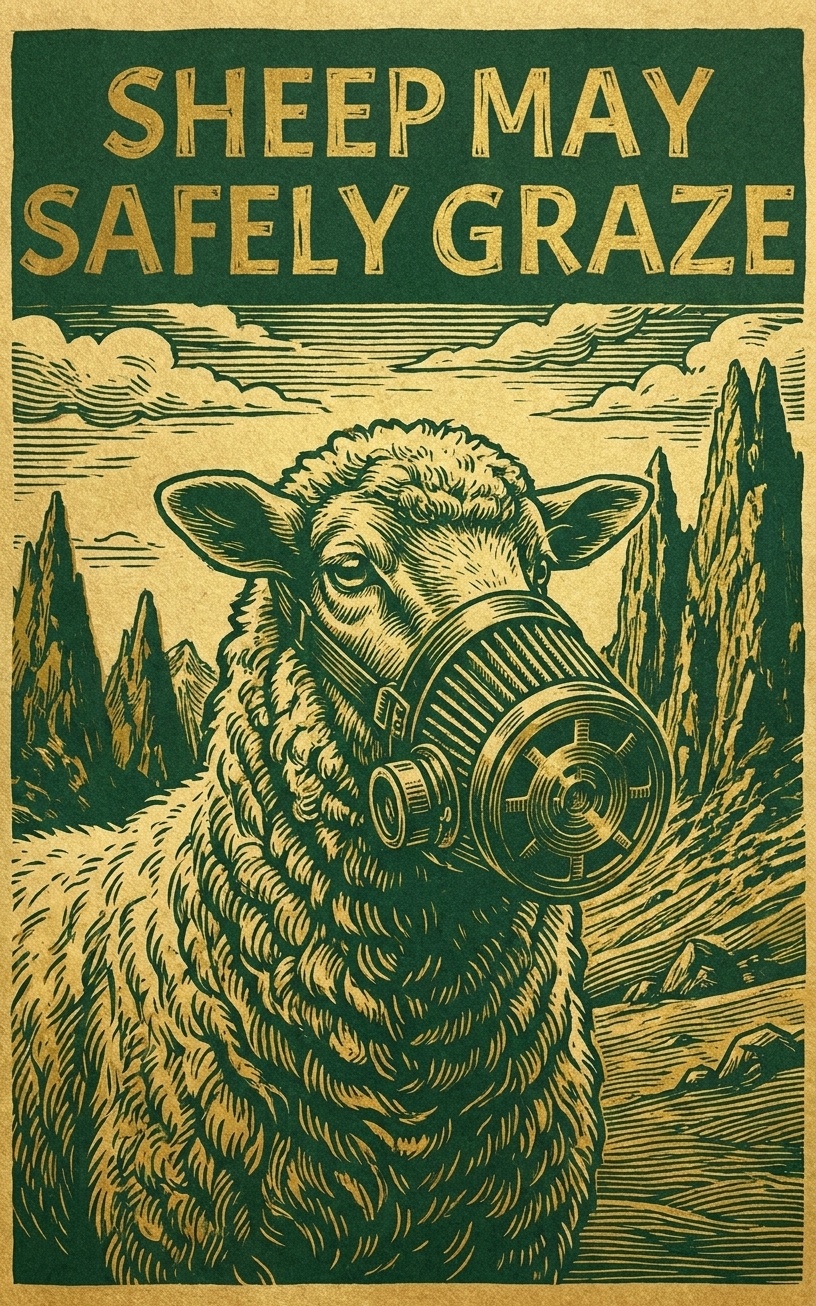
Sheep May Safely Graze (Part 5)
Xabier did not sleep. He sat at the workbench with the note and the map and the gun. Xabier tried to remember writing the words. He could not.
At some point his hand went to the back of his neck. It did that when he was tired. There was a little ridge of scar at the base of his skull, smooth and round, about the size of a coin. Xabier had always had it. He had a vague idea; he got it falling off a wall in the village. He could not remember the wall.
He stood up and looked at the flock.
“Which of you knew?” he asked them. “Eh? Which of you watched me write it?” Maite lay near the gate with her chin on Ander’s back. The black sheep stood off by himself, the way he always did. The black sheep never stared. Xabier had never thought about that either.
The freighter had holds aft of the barn. The company man at Barcelona had told him they were sealed. Old cargo, nothing to concern a shepherd. Xabier had never thought about them. Now he took his staff and a length of wire and went to the rear bulkhead.
The hatch was rusted shut, but rust was nothing. He worked the wire into the lock and the staff into the seam and leaned. He leaned harder. The hatch groaned and gave. Cold air rolled out over his boots and set the sheep stamping in the dark behind him.
The lights came on as he stepped through. Long white tubes, one after another, down a long low room.
Berths. Tanks of clear glass, each one long enough for a man, stacked two high along both walls. He walked down the row and counted them. Fifty on the left. Fifty on the right. One hundred.
Ninety-nine were cracked open. Their lids hung on bent hinges. Dried sleep fluid stained the floor under them in old brown rings. Some of the stains were so old they had flaked away.
One berth was different. The last one, at the end of the row. Its lid was closed and clean. The fluid inside was fresh and blue. A feed line hung from the head of the berth, and at the end of the line was a small round plug.
About the size of a coin.
Xabier touched the back of his neck again.
Above the berth, a plate read 100.
He walked back up the row and read the plates. 1. 2. 3. All the way to 99. Some of the old berths had things left in them. A boot. A comb with teeth missing. In berth 41 someone had scratched a little sheep into the glass with a nail, and under it, in a crooked hand, egun ona. In berth 63 there was a jar. The jar was empty, but the inside was stained red.
He did not touch it.
“Pomegranate,” he said, and his voice came out small in the cold room, like a boy’s in a church.
He stood there a long time. The loudspeaker clicked. Somewhere in the barn the Cantata began, the slow opening bars of a movement. Xabier didn’t remember ever having heard it play. A panel beside the berth lit up. Words scrolled across it in plain block letters.
SOLITON PASTORAL TRUST. SHEPHERD CYCLE LOG.
He touched the panel. The music changed with every page. He read.
This was a template. One man, indentured, Basque, twenty years old. The Trust owned his pattern under the terms of his contract. Each cycle, the ship grew and thawed one shepherd who tended the flock. When the pattern aged out, or died, or failed, the next one was thawed. The old one was “released to the plain.” Supplies for one. Barn for one. Rations for one.
There was a note under crew orientation. Shepherds were told that time took on a different meaning on the plain. Decades passed on Earth while he aged a year. An explanation for any lost memories.
He thought about his mother making jelly. Long dead, he had presumed. He had presumed so many things.
At the bottom of the log was the manifest. He read the last line twice.
SHEPHERD STOCK: 99 AND 1.
Ninety-nine spent. One active.
He had counted his flock the first day by that number. He had laughed at the company’s poor way of saying one hundred sheep. It had never been about sheep.
He was the one. He was copy one hundred.
“Ehun,” he said, the way a farmer reads a bad price at the market. “One hundred. Not a shepherd. A number on a shelf.”
He read the rest of it because he could not stop. Cycle lengths. Ration weights. A column for each copy with a date thawed and a date released. Some of them had lasted years. Some of them had lasted weeks. Copy 12 had a note beside his number. Refused belt. Released early. Copy 58 had a note. Attempted to open aft hold. Released. Copy 97 had a date thawed and nothing else. No date released. No note. Only a blank.
He scrolled to his own line. Unit 100. Active. The date thawed was forty years after the date the freighter landed. Nineteen months of hibernation along the Soliton Fold, he believed. He had never been in the fold. He had been in a tank fifty steps from his own bed waiting to be thawed.
He thought of the spaceport outside Barcelona. He could see it. The gate. The smell of fuel. The company man with the clipboard. He could see all of it as clearly as he saw his hand. He was sure of it.
Somebody had been there. Somebody had run as fast as he could to that spaceport. Only it wasn’t him. Trust had taken that running boy and put his thoughts, memories, and all in a hundred heads.
“Gizon adimentsua,” he said to the empty berths. He did not smile this time.
Xabier went back through the barn in a daze. The flock was awake. They stood in their filters in the dark, and a line of ewes stood apart from the rest, staring at him, the way they had stared when he worked at the bench. He walked past them. Their heads turned, slow, all together, following him.
He stopped. He took a step left. The heads turned left. He took a step right. The heads turned right.
Xabier looked down at his weight belt.
It was a plain thing. Heavy canvas with lead bars sewn in pockets. But one pocket had always been stiffer than the others. He had thought it was a bad bar. He cut the stitches with the tip of his shears. Inside lay a flat black wafer the size of a playing card, with a single green light that glowed around his fingers.
He unbuckled the belt and hung it on a hook by the door. He walked to the far end of the barn.
The ewes did not follow him with their eyes. They looked at the belt. A few of them drifted toward it, slowly, the way sheep drift toward a man with a bucket. He retrieved the belt. Every head swung back to him.
“Zer zarete?” he asked them. What are you?
They did not answer. They were sheep. But too mechanical. Too observant.
He heard a snap. Hung the belt back and rushed to the window.
The hunters crossed the array wire along the fence. A shiver of silver at the gate. Another at the south wall. Another, two more, on the roof. They did not go after the sheep. The sheep were locked in. Instead, he saw a blue snap, and a harpoon punched through the thin tin by the feed bins. The cable went tight. The bin tipped and slid and scraped across the floor and went out the slit window in a shower of grain.
He ran for the bins. Another snap. Another bin went. He grabbed the last one and wrapped his arms around it and held on while the cable hummed and the bin bucked under him like a calf. Then the cable went slack. Someone out there had cut it rather than let it drag him through the window.
He lay on the floor with his one bin of feed and listened to them go. Slowly his breath changed to a gentle sigh. The sheep slept under the belt.
He did not sleep. He sat up with the hunter’s gun across his knees, and the lamp turned low. Around midnight, by his own count, the loudspeaker clicked, and the middle refrain of the Cantata played, the one he had heard the night he built the array. The line of ewes stood apart and stared at him. He stared back.
“Who is watching?” he asked them. “Eh? Who is it?”
The music stopped. The ewes kept staring.
In the morning there was a sack by the door. It held berries, the red ones like pomegranates that tasted of apples. On top lay a note, folded in four.
You are the hundredth. We are what is left of the others. Give up the belt, and the Trust will return you to the tank and take you back. Fight, and we will starve you.
It was signed with one word. Zaharra. The Old One. The “Z” had a fishhook tail.
He sat in the doorway with the sack in his lap. The red sun hung where it always hung. The white point burned beside it, a little brighter than yesterday.
Xabier understood then. The hunters had never wanted the sheep. They had wanted him.
© 2026, Michael Shawn Sommermeyer. All rights reserved.



Leave a Reply