Wordsmith Holler

Original Pulp Fiction

Tag: space

  • Sheep May Safely Graze: Sheep May Safely Graze (Part 4)

    Sheep May Safely Graze: Sheep May Safely Graze (Part 4)

    The two suns climbed the west sky. One was an old red sun, fat and slow. The other was a small white point, sharp as a needle. It had not been there when Xabier first came to the Slydal Plain. He had stopped wondering about it. A planet this far out could keep whatever stars it liked.

    Below him, the five sheep grazed in the triangle corner of the field. The two rams pulled at the grass. The doe-eyed ewe stayed close to her lamb. The old ewe stood a little apart, chewing slowly, her weight belt sagging on her thin haunches. Xabier lay flat behind the rock with the controller in his lap. The buried wire ran under his elbow like a vein.

    He waited. Nymphs bounced in his hair. The locusts hummed. A sheep bleated far up the field, and the flock answered.

    Nothing moved in the corner.

    “Etorri,” he whispered. “Come on, then.”

    He set his thumb on the knob and turned it a hair. A needle on the dial twitched. He turned it again. The posts in the corner gave off a faint tick, tick, like rain on the freighter’s hull. He swept the dial slowly from one end to the other. Nothing. He swept it back.

    Halfway up the dial, the air in the corner shivered.

    It looked like heat over a road. Then it looked like a man. Four outlines stood among the bait sheep, silver grey, edged in thin light. A fifth stood farther back near the cliff, as if he had come to watch. They wore hoods and long cloaks that hung oddly in the heavy, still air. Filters covered their mouths, just like his own. Each held a long gun with a fat drum under the barrel, and a fine cable wound on the drum.

    They were men. Not monsters. Men.

    Xabier’s mouth went dry. He had pictured bows and arrows. He had pictured something with claws. He had not pictured men who breathed through filters and stood on two legs in his field.

    One of the outlines looked down at his own arm. He had seen himself go silver. He jerked his head around at the others. The array had worked. They knew it.

    The four hunters scattered like quail. But one of them was quicker with his fear than the rest. He swung his gun and fired. A blue flash snapped from the barrel, a spark where the cable left the cloak. The harpoon took the bigger ram in the neck from no more than ten meters off. The ram fell bleating. The drum whined, and the cable went tight, and the ram began to slide across the grass toward the rocks.

    “Ez!” Xabier was on his feet before he thought about it.

    He grabbed his staff and the shears from his belt. He pushed off the rock and flew. One stroke of the staff against the ground, then another, rowing through the dense air in long, low arcs. He came down beside the sliding ram and caught the cable in the blades of his shears. It was thin as fishing line and tough as wire. He squeezed with both hands. The cable parted with a crack and whipped back into the ripple.

    The ram lay still. Blood ran into the wool at his neck. Xabier knew that wound. He had seen it on three sheep already.

    The hunters ran for the cliffs. Their outlines flickered as they crossed the array wire, silver, then nothing, then silver again. The slowest of them was the one at the back, the watcher. He moved like a man with stiff knees. His cable trailed behind him, loose, unreeled, dragging through the bracken.

    Xabier dug in his staff and pushed. He flew. He landed with both boots on the trailing cable, and the old hunter jerked to a stop like a dog at the end of a lead.

    They both went down. In this gravity, going down took a long time. They tumbled together in a slow, ugly arc, cable wrapping their legs, the gun spinning away. The hunter’s elbow caught Xabier in the ribs. Xabier grabbed a fistful of zamarra. It was curly, tough leather, and he clung to the wool. It tore at the hood, and the hunter twisted away.

    They landed in the grass. Xabier toppled over. He held the torn hood in one hand and raised his staff with the other.

    He did not swing.

    He was looking at his own face.

    It was older. Forty years older, maybe more. The sandy brown hair had gone grey and thin. Deep lines ran from the nose to the corners of the mouth. But it was his nose. His chin. His small ears that his mother used to tug. The eyes were his eyes, set in a face the sun had worked over for a long time.

    The old man looked up at him. His filter hissed. Something passed over his face that Xabier could not read. It looked like grief.

    “Txiki,” the old man said.

    Little one.

    Then he twisted like an eel, kicked free of the cable, and was up and gone in three long bounds. His cloak flickered silver over the array wire and vanished into the rocks. He left the gun in the grass.

    Xabier sat in the bracken for a long time. His ribs hurt. His hands shook. The flock watched him from up the field.

    He picked up the gun. It was heavier than it looked. The drum held a long coil of the fine cable, and the harpoon was a short barbed shaft with a ring at the tail. He wrapped his hand around the grip.

    It did not fit. The grip had been worn smooth by years of a hand, and the hand had been on the wrong side. The thumb groove sat on the right. The finger grooves curved for a left hand. Xabier was right handed. He had always been right-handed. His mother had slapped his left hand off the spoon until it was.

    He set the gun down.

    “That’s not my hand,” he told the ram. “That’s a left hand. Mother would have slapped it.”

    He thought of the face he had glimpsed in the ripple that first day, when the black sheep fell. He had told himself it was a trick of the light. It had looked familiar even then. He had not let himself wonder why.

    He sat with the dead ram until the chimes rang. Tin, ting, tin, tang. The flock came down off the hill on its own, the way it always did when the bells played. He walked the four remaining sheep back to the barn. The old ewe walked the slowest. He dragged the ram himself, rowing with his staff, and laid him in the shade by the door.

    Inside, he fitted the sheep with fresh filters. He did not wish them a good day. He went to the tack drawer.

    The note was where it had always been, under the spare straps. He had found it his first day, folded in four. He had always thought the shepherd before him had left it. A kind man, he had decided. A careful man. He unfolded it now.

    Kontuz ehiztariekin. The hunters will come for the five.

    He had read it a hundred times and thought it was nonsense.

    “The five what?” he had asked the sheep that first day. Maite had only chewed.

    He knew now.

    He took the note to the workbench and laid it next to his map of the field. He had drawn the map two days ago. Squares at each post. Thin lines for the wire. Labels in his own careful hand. Hegoaldeko zutoina. Zelaia. Zuhaitz.

    He looked at the note. He looked at the map.

    The “K” had the same lazy loop. The “h” leaned the same way. And there, in ehiztariekin, the “z” had a crooked tail that dropped below the line and hooked back. He had made that “Z” since he was six years old. His teacher had called it a little fishhook. No one else on Earth made a “Z” like that.

    He looked at Zelaia on his map. The same fishhook.

    The warning was in his own handwriting.

    “Nirea da,” he said to the empty barn. “The note’s mine. I wrote it, and I don’t remember writing it.”

    Read more: Sheep May Safely Graze: Sheep May Safely Graze (Part 4)
  • Sheep May Safely Graze: Sheep May Safely Graze – Part Two

    Sheep May Safely Graze: Sheep May Safely Graze – Part Two

    From his knapsack, Xabier retrieved a crust of sourdough bread and a jar of jelly made from some red berries that resembled pomegranate seeds and tasted like earth apples.

    He thought about his mother making jelly. Long dead, he presumed. When he signed up for this job, he was told time took on a different meaning here. Although he barely aged a year, decades passed on Earth, and his mother now likely rested in a plot under the olive trees.

    He covered the bread in jelly and brought the crust up to his lips for a bite.

    “Ze arraio?”

    He saw the flock rush away from the center of the meadow and make a stand against the far rocks. Xabier saw the black and two white sheep fall on the ground, bleating like they were dying. He rose, grabbing his staff and using it like an oar to bounce across the field to the fallen sheep. He dropped to the ground in a dead run to the center of the herd. He touched the neck of the nearest animal and brought up a hand covered in blood.

    Another animal fell, and the herd ran away from the danger. Xabier thought he saw a ripple of light and a blue flash right before the ewe fell. Her lamb spun away as another blue flash zipped from a ripple of light.

    Something was out there hunting the sheep!

    “Atzera,” he shouted, but the threat seemed to move closer to the herd. He saw another ripple and, for an instant, he thought he saw a face. Another animal fell, and he decided that instant to move the herd.

    He whistled long and hard. The sheep scrambled away from the rock fall and ran toward the barn.

    “Laster exekutatu. Run, my lovelies.”

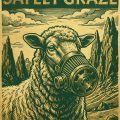
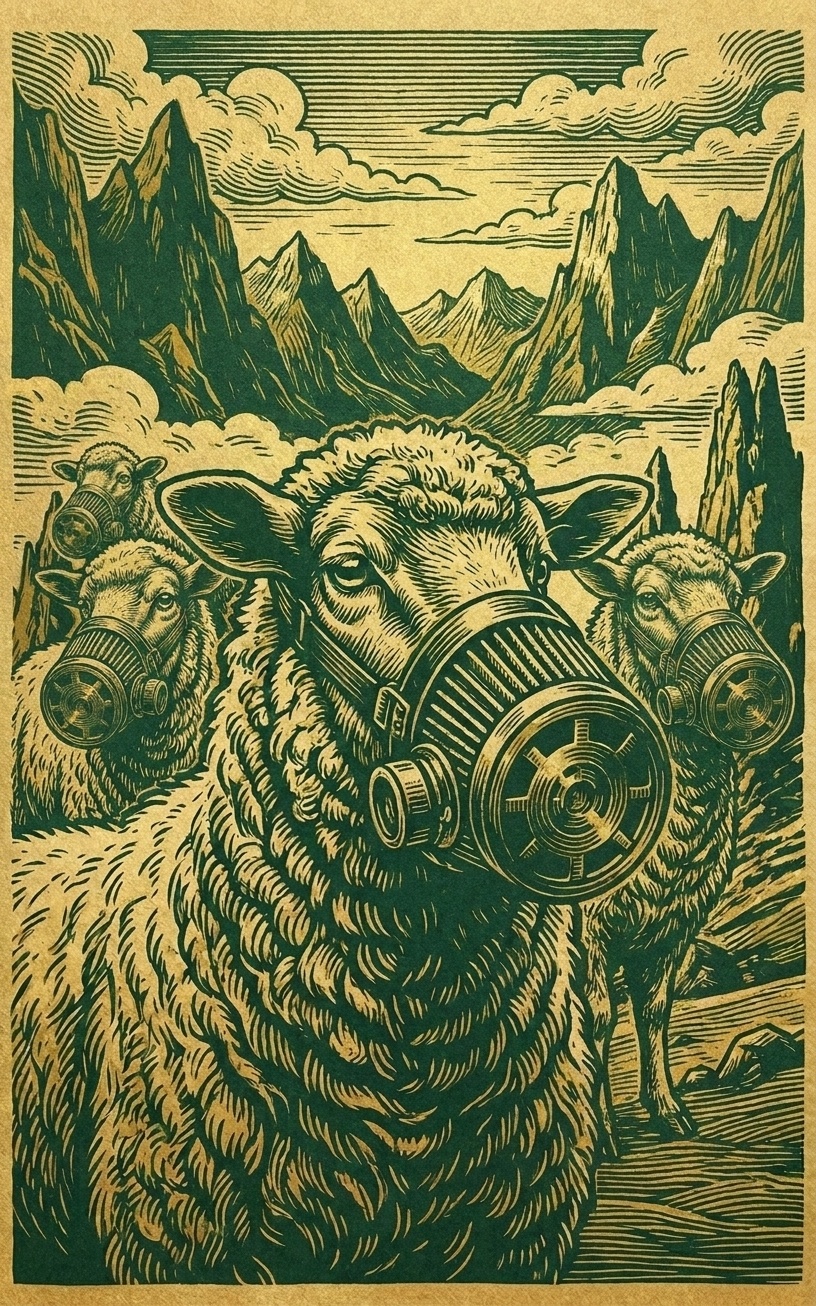
    He flew the length of his staff and bounced up to the herd. He paddled forward until he reached the barn door, opening it quickly to let the sheep spill in. Safe inside, the animals stood in their breathing masks against the far wall of the barn. 

    A collective bleating sound could be heard as ewes searched for their lambs. Xabier looked through a portal to the meadow below. He saw a distinct ripple pattern moving the dead sheep off the field until five animals bordered the far side of the meadow.

    He then saw the dead sheep vanish from the meadow as if they were erased. He had been warned about the hunters but never thought he would encounter them.

    Read more: Sheep May Safely Graze: Sheep May Safely Graze – Part Two
  • Sheep May Safely Graze: Sheep May Safely Graze – Part One

    Sheep May Safely Graze: Sheep May Safely Graze – Part One

    Tin, ting, tin, tang rang the bells of Cantata Nº 208. The boy rubbed sleep from his eyes and covered them to block the dancing sunlight streaming through a slit in the roof. He slipped on boots, a filter, and gloves.  The red sun inched across the sky and it would be half an Earth-month before nightfall. Without the chimes, he might have missed feeding time.

    Small frame, calloused hands, and a full head of sandy-brown hair, he looked very much like a boy, although he celebrated his 20th birthday three Earth months ago. He lost track of the time on this planet where the sun hung in the sky for roughly 37 Earth days. 

    Xabier escaped indentured Kleroaren army servitude by signing on as a shepherd on Caelora. Neither the nobles nor the clergy appealed to his solitary habits and rural ambitions, so he ran as fast as he could to the spaceport outside Barcelona. 

    Nineteen months of hibernation, passage in the Soliton Fold, and then he arrived. Xabier was left alone with a coat, a knapsack, a blanket, a staff, and some sheep to herd on the outskirts of the galaxy.

    The Caeloran atmosphere scattered sunlight into shades of violet no Earth sky could reproduce. The air felt dense as he floated to the barn sitting in the center of the Slydal Plain. The sheep numbered 99 and 1 huddled in a stable fashioned from a rusting freighter. The herd had trampled bracken across the metal floor, which the sheepherder had cut earlier when the sun sat only inches from its current position. He wished for nightfall if only to see the stars of the Pyrenees Constellation.

    While Caeloran came close to breathable air, the shepherd and sheep still needed a filter to achieve a good mix. He retrieved a bag of filters from the tack and proceeded to fit them around black noses. 

    “Egun ona Maite.” Xabier pulled the filter straps tight against the animal’s neck, then placed a weight belt on her haunches.  

    “Egun ona Ander.” He wished each animal a good day until the wooly faces stood in a corner anticipating the rush to the pasture.

    Xabier slipped on a weight belt, picked up a staff, and opened the gate. Bright, white light rushed into the barn, and the sheep bounced back into the shadows. “Nire maitaleak. Run, my lovelies.” 

    The sheep leaped from the barn, spilling out on the bright green pastureland, their front feet floating off the ground, anchored to the soil with only their hindquarter weight belts. Soon they settled down, their heads bobbing off the ground with each taste of the grass, as if they were bottom-heavy drinking birds bouncing into a glass.

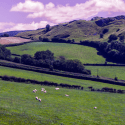
    He took flying leaps over to a rock slab, watching the sheep graze nestled between towering cliffs and rock outfalls in the high-mountain valley. Nymphs and prairie gnats bounced in his hair, he smelled lavender rose, and he heard the sound of locust hum interrupted now and then by the bleating of sheep. 

    The shepherd believed this valley felt most like his home on Earth.

    Read more: Sheep May Safely Graze: Sheep May Safely Graze – Part One
  • March 7, 2017 Scribble

    March 7, 2017 Scribble

    You can read this if you wish although it consists of thoughts and fragments as I attempt to free write 750 words every day. Some of this may end up in a Story or a Conversation. Anyway, this is how one learn and shapes up The Craft.

    The Big Squeeze is coming to Las Vegas. The Spaghetti Bowl, a large mess of on ramps and off ramps between the US 95 and I-15 will soon be reduced to two lanes. It already becomes two lanes on US-95 under the Bowl, so I’m not sure how this is a squeeze, but through media hyperbole and advertising, I’m to understand this will be terrible.

    This morning, I decided to find an alternative route. On the advice of some friends, I decided to try North Fifth, a new road into North Las Vegas.

    After fifteen minutes waiting for a light to change and let three cars through at a time, I’ve decided I can suffer through the impending peril of the Big Squeeze. Even if I sit for 5 extra minutes, it will surely beat a 55 minute commute to go 20 miles via surface streets. This is ranting I know, but you have to start 750-words somehow.

    We spring back this weekend. Frankly, this just means getting up earlier. Remember to set your clocks ahead. (Don’t think about it too much: Your head will explode).

    Sequoia Strawberries in the flower bed mulch
    Lined up like bare root roses
    Patted safe in the warm soil
    Watered and blessed; a hopeful refrain.

    Spring lasts a few days before summer rays
    Bear down on the garden beds
    Warming the soil to dry dust
    A delicate balance to keep them moist.

    The morning frost reminds spring follows winter
    Breezes as March enters like a lion
    Or sneaks in like a lamb.
    Either way, the garden struggles to bloom.

    A small leaf springs up from the bare root tip
    As roots firmly establish themselves
    And the plant becomes accustomed to its new home.
    It spreads out to take space.

    Small droplets in the morning light
    On large leaves of green vermillion
    Summer sun gobbles up the water
    As ladybugs jump through the delicate flowers.

    “Are you drinking enough water?”

    “I think so.”

    “It’s getting hotter and you need to be refreshed.”

    “I went to the bathroom three times tonight.”

    “You’re diabetic. That’s a sure sign of the disease.”

    “I don’t suppose four tall glasses of water had anything to do with it.”

    In these writing exercises you are supposed to write whatever comes to your head, in any order, without stopping. This came to my head just now.

    S. I. Hayakawa was a U.S Senator from California, and before that he was a semanticist at San Francisco State University. I first read his book Language and Action in high school. The idea Bessie the Cow was an abstraction allowed me to add only those details that made her a cow, rather than endlessly describe all of her features. Abstraction allows writers to write a picture that others fill in. Hayakawa warned to stay at the top of the abstraction tree, otherwise you could lead others into an existential hell.

    Trees have a colored leaf. And the leaf is made of smaller parts from veins to individual cells. Staying at the top allows the reader to fill in the abstractions, without the writer having to describe the color of the veins or explain the arrangement of the cells. However, sometimes a writer wants to describe these things. Knowing when to stop is the art of writing. A writer must be careful not to chase themselves around in circles!

    Hayakawa also addresses the power of words to hypnotize and manipulate. If a person can be convinced a brown cow is really white through powerful descriptions, then a writer can powerfully draw a crowd in with the force of prose. He cautions readers to avoid taking whatever a person says at face value; question them and their motivations. Abstractive communication allows writers to rely on simile, metaphor, irony and pathos to communicate an idea. Abstraction has power as long as everyone agrees on the definition of the abstraction.

    Too deep? Enough philosophy on the mechanisms of writing.

    “I just don’t feel motivated or respected.”

    “You hate your job?”

    “Just the people. Nobody sees my contribution.”

    “So you’re looking for a reward?”

    “I would like to be respected and given a little credit.”

    “For showing up?”

    “For making this place work despite the lack of respect.”

    “You received a paycheck this week?”

    “Yes.”

    “I think you they must like you.”

    I’m running out of words for this session’s writing activity and likely this will end long before I ever get to the bottom of a deep well. There. We now have 750-words!

    Read more: March 7, 2017 Scribble
  • March 2, 2017 Scribble

    You can read this if you wish although it consists of thoughts and fragments as I attempt to free write 750 words every day. Some of this may end up in a Story or a Conversation. Anyway, this is how one learn and shapes up The Craft.

    According to my new writing goal, I am supposed to just write down whatever comes to my head and finish up in 750 words. The whole thing sounds a bit of a waste of time, frankly. I don’t have the luxury of writing nothing; there is so much more to write and get done.

    Yet, here I am just writing. And counting time.

    (more…)

    Read more: March 2, 2017 Scribble