The two suns climbed the west sky. One was an old red sun, fat and slow. The other was a small white point, sharp as a needle. It had not been there when Xabier first came to the Slydal Plain. He had stopped wondering about it. A planet this far out could keep whatever stars it liked.
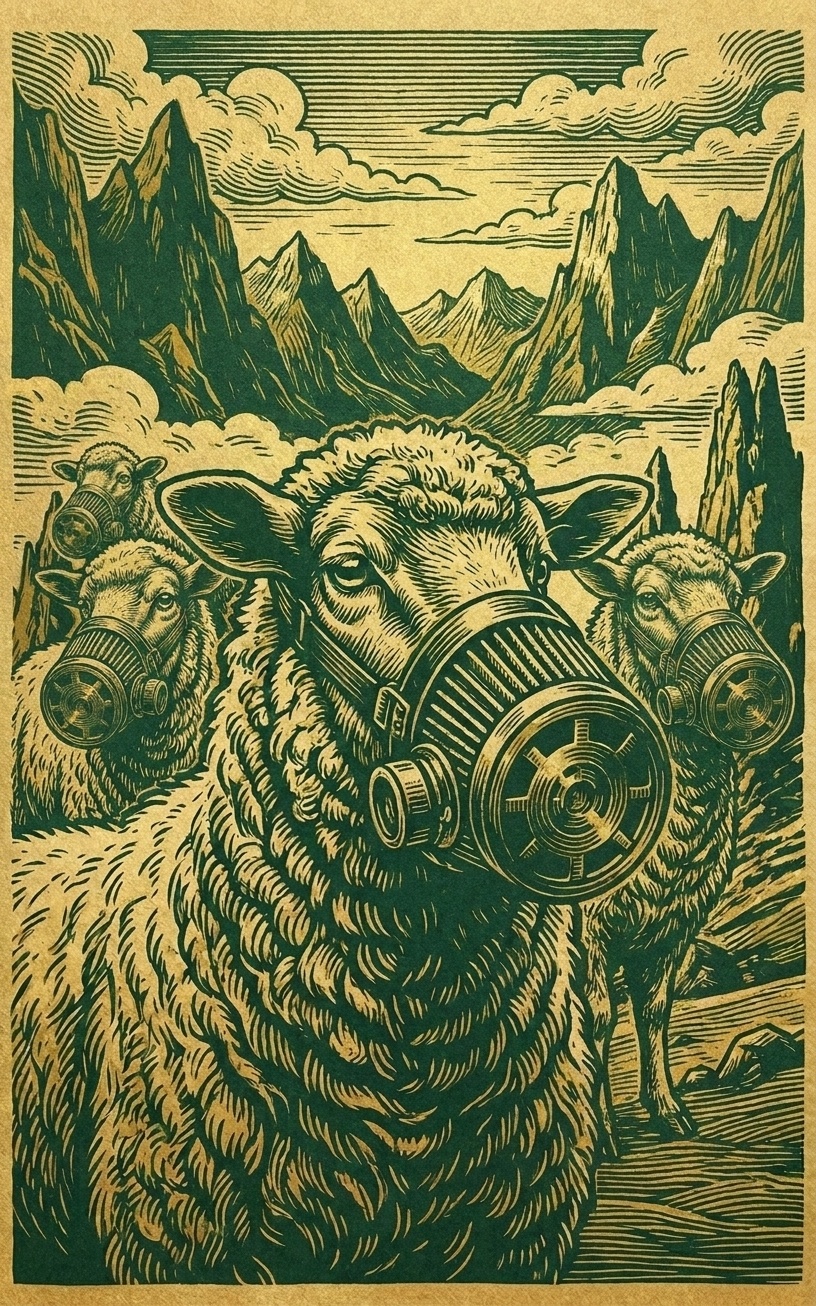
Below him, the five sheep grazed in the triangle corner of the field. The two rams pulled at the grass. The doe-eyed ewe stayed close to her lamb. The old ewe stood a little apart, chewing slowly, her weight belt sagging on her thin haunches. Xabier lay flat behind the rock with the controller in his lap. The buried wire ran under his elbow like a vein.
He waited. Nymphs bounced in his hair. The locusts hummed. A sheep bleated far up the field, and the flock answered.
Nothing moved in the corner.
“Etorri,” he whispered. “Come on, then.”
He set his thumb on the knob and turned it a hair. A needle on the dial twitched. He turned it again. The posts in the corner gave off a faint tick, tick, like rain on the freighter’s hull. He swept the dial slowly from one end to the other. Nothing. He swept it back.
Halfway up the dial, the air in the corner shivered.
It looked like heat over a road. Then it looked like a man. Four outlines stood among the bait sheep, silver grey, edged in thin light. A fifth stood farther back near the cliff, as if he had come to watch. They wore hoods and long cloaks that hung oddly in the heavy, still air. Filters covered their mouths, just like his own. Each held a long gun with a fat drum under the barrel, and a fine cable wound on the drum.
They were men. Not monsters. Men.
Xabier’s mouth went dry. He had pictured bows and arrows. He had pictured something with claws. He had not pictured men who breathed through filters and stood on two legs in his field.
One of the outlines looked down at his own arm. He had seen himself go silver. He jerked his head around at the others. The array had worked. They knew it.
The four hunters scattered like quail. But one of them was quicker with his fear than the rest. He swung his gun and fired. A blue flash snapped from the barrel, a spark where the cable left the cloak. The harpoon took the bigger ram in the neck from no more than ten meters off. The ram fell bleating. The drum whined, and the cable went tight, and the ram began to slide across the grass toward the rocks.
“Ez!” Xabier was on his feet before he thought about it.
He grabbed his staff and the shears from his belt. He pushed off the rock and flew. One stroke of the staff against the ground, then another, rowing through the dense air in long, low arcs. He came down beside the sliding ram and caught the cable in the blades of his shears. It was thin as fishing line and tough as wire. He squeezed with both hands. The cable parted with a crack and whipped back into the ripple.
The ram lay still. Blood ran into the wool at his neck. Xabier knew that wound. He had seen it on three sheep already.
The hunters ran for the cliffs. Their outlines flickered as they crossed the array wire, silver, then nothing, then silver again. The slowest of them was the one at the back, the watcher. He moved like a man with stiff knees. His cable trailed behind him, loose, unreeled, dragging through the bracken.
Xabier dug in his staff and pushed. He flew. He landed with both boots on the trailing cable, and the old hunter jerked to a stop like a dog at the end of a lead.
They both went down. In this gravity, going down took a long time. They tumbled together in a slow, ugly arc, cable wrapping their legs, the gun spinning away. The hunter’s elbow caught Xabier in the ribs. Xabier grabbed a fistful of zamarra. It was curly, tough leather, and he clung to the wool. It tore at the hood, and the hunter twisted away.
They landed in the grass. Xabier toppled over. He held the torn hood in one hand and raised his staff with the other.
He did not swing.
He was looking at his own face.
It was older. Forty years older, maybe more. The sandy brown hair had gone grey and thin. Deep lines ran from the nose to the corners of the mouth. But it was his nose. His chin. His small ears that his mother used to tug. The eyes were his eyes, set in a face the sun had worked over for a long time.
The old man looked up at him. His filter hissed. Something passed over his face that Xabier could not read. It looked like grief.
“Txiki,” the old man said.
Little one.
Then he twisted like an eel, kicked free of the cable, and was up and gone in three long bounds. His cloak flickered silver over the array wire and vanished into the rocks. He left the gun in the grass.
Xabier sat in the bracken for a long time. His ribs hurt. His hands shook. The flock watched him from up the field.
He picked up the gun. It was heavier than it looked. The drum held a long coil of the fine cable, and the harpoon was a short barbed shaft with a ring at the tail. He wrapped his hand around the grip.
It did not fit. The grip had been worn smooth by years of a hand, and the hand had been on the wrong side. The thumb groove sat on the right. The finger grooves curved for a left hand. Xabier was right handed. He had always been right-handed. His mother had slapped his left hand off the spoon until it was.
He set the gun down.
“That’s not my hand,” he told the ram. “That’s a left hand. Mother would have slapped it.”
He thought of the face he had glimpsed in the ripple that first day, when the black sheep fell. He had told himself it was a trick of the light. It had looked familiar even then. He had not let himself wonder why.
He sat with the dead ram until the chimes rang. Tin, ting, tin, tang. The flock came down off the hill on its own, the way it always did when the bells played. He walked the four remaining sheep back to the barn. The old ewe walked the slowest. He dragged the ram himself, rowing with his staff, and laid him in the shade by the door.
Inside, he fitted the sheep with fresh filters. He did not wish them a good day. He went to the tack drawer.
The note was where it had always been, under the spare straps. He had found it his first day, folded in four. He had always thought the shepherd before him had left it. A kind man, he had decided. A careful man. He unfolded it now.
Kontuz ehiztariekin. The hunters will come for the five.
He had read it a hundred times and thought it was nonsense.
“The five what?” he had asked the sheep that first day. Maite had only chewed.
He knew now.
He took the note to the workbench and laid it next to his map of the field. He had drawn the map two days ago. Squares at each post. Thin lines for the wire. Labels in his own careful hand. Hegoaldeko zutoina. Zelaia. Zuhaitz.
He looked at the note. He looked at the map.
The “K” had the same lazy loop. The “h” leaned the same way. And there, in ehiztariekin, the “z” had a crooked tail that dropped below the line and hooked back. He had made that “Z” since he was six years old. His teacher had called it a little fishhook. No one else on Earth made a “Z” like that.
He looked at Zelaia on his map. The same fishhook.
The warning was in his own handwriting.
“Nirea da,” he said to the empty barn. “The note’s mine. I wrote it, and I don’t remember writing it.”